- Recommend on FacebookTweet about it

- Recommend on FacebookTweet about it

- Recommend on FacebookTweet about it

- Recommend on FacebookTweet about it
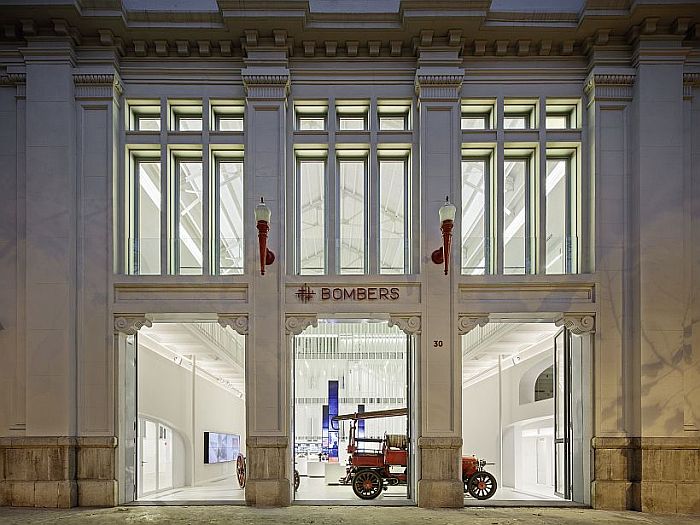
The architects’ deliberate lyricism-devoid text (below) is missing any reference to aesthetics or “philosophy”. However, when I visited the (yet unfinished, at the time) museum with Miguel Roldán, I felt it as a poetry-filled project, even yielding a slight dream-like character: the light turns almost material, the same bright colour is layered over new and old elements, to which we may add the delicate articulations and curved gaps cut in the old walls, and even the repetition and obsessive overlapping of vertical metal items.
- Recommend on FacebookTweet about it

The former Technical School of Aviation from the outskirts of the town of Mediaș, at the exit towards Sighișoara, was about to be degraded into disappearance. However, lately, it has been changing functions, some buildings are disappearing, others are rehabilitated, new buildings pop up. A social program – protected workshops for vulnerable people – has found a place in the former mess hall. ADP’s project is an example of reinventing a construction, but also of re-densifying the town’s outskirts, of building a public pole as well as an argument in favour of limiting the uncontrolled expansion of the town.
- Recommend on FacebookTweet about it

Intro: Modern by sound omission. The virtue of abstinence
Text: Cosmin O. Gălățianu
We make a note on the work seen from outside: it is clear that retrospection to the work, to the working, has a modernity of itself. In other words, the way the work is regarded, for instance the work of architecture, legitimises or not its modernity. Such a regard, a recent one, we may say, has twisted towards a type of architecture that is convenient (and here we mainly refer to the architects) by its implacable righteousness.
- Recommend on FacebookTweet about it
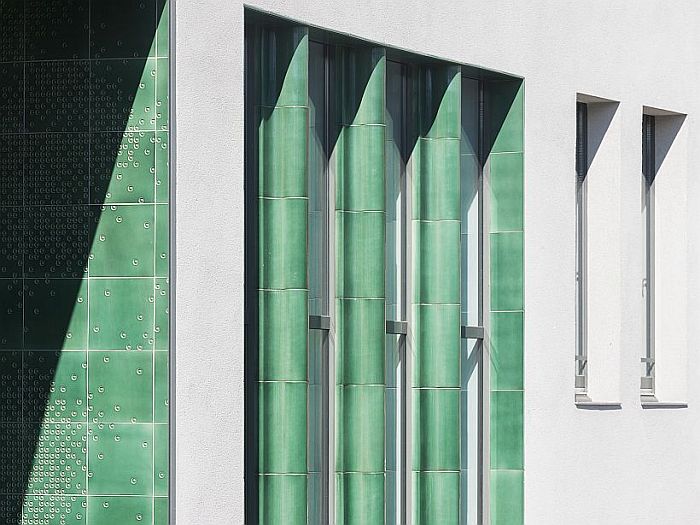
How does one build nowadays, in a central, tethered and characteristic historical fabric, a new public building? The FKM project of Oradea started precisely from this question, and by modelling the morphology against the city’s neighbouring spaces was the first step.
Project: Atelier FKM
Text, Photo: Andrei Mărgulescu- Recommend on FacebookTweet about it

Intro: Captive autonomy
Text: Cosmin O. GălățianuThe city, but mostly the European city, keeps its body under surveillance. It fears to have its healthy components excised, it feels the ghosts of the amputated ones, and it treats its dysfunction with cautious motions – very much like someone with a heart disease takes care of their body.
- Recommend on FacebookTweet about it

Text: Cosmina Goagea
Photo: Joachim EngelstadA large city is faster than people, and architecture projects are slower than technology. Obviously, current economy gives rise to a great social injustice. All kinds of emergencies condense time so that crisis becomes the norm, the world is increasingly more busy and hotter day after day. A generation of people who are not working for a remote future, but for one that is already here, who are trying to change, on the fly, the way of city-living, the paradigm and the democracy.
- Recommend on Facebook

Architecture.
City.
Society.
Architecture.
City.
Society.
≡
Articles published by: Nickname

