Text: Ștefan Ghenciulescu
Foto: Laurian Ghințoiu
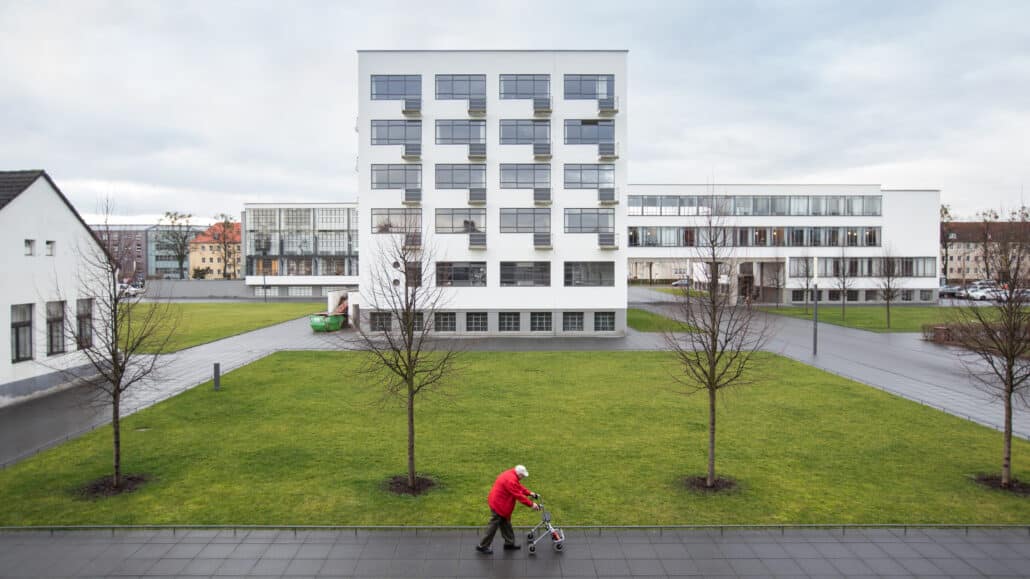
Not everybody knows, but the Bauhaus ensemble in Dessau, comprising the famous main building and the professors’ quarters is not just a museum, but the headquarters of an international academy that teaches post-university courses on design and research. This place is alive, open to the future, where the foreign student and professor ratio is overwhelming.
Dessau town lies in Sachsen-Anhalt Land, în the ex-Eastern Germany, a bastion for the extreme right party, Alternative für Deutschland (AfD). It occupies first place in national preference and would take 40% of the Land’s votes. And it doesn’t love Bauhaus at all.
As I found out from a newspiece în Reuters, “Bauhaus stands for deracination. Bauhaus stands for dislocation of architecture,” says Thomas Tillschneider, the party’s spokesperson on cultural issues. Tillschneider, who, ironically, is originally from the Romanian city of Timișoara—one of the cities that symbolize European multiculturalism—states that the AfD does not want to ban the school, but has suggested that financial support would be withdrawn once they win the local elections. Given that the party generally attacks subsidies for “anti-German culture and art,” we can pretty much guess what to expect. In fact, not at all surprisingly, the party models its political strategy on that of Donald Trump: the Fascist International, Now in Architecture, Too.
Like all far-right parties and movements, the AfD also tries to deny its ties to its interwar predecessors. This makes it all the more important to look back at the past.
In 1931, Nazism had not yet seized power. Local elections were taking place. And in a National Socialist leaflet for the municipal elections in Dessau in October 1931, the first point of the platform was:
„Immediate cancellation of all expenditures for the Bauhaus. Foreign teachers are to be dismissed without notice, since it is not in accordance with the responsibility which good community leadership must bear toward its people, that German comrades starve, while foreigners are paid in abundance out of the tax pennies of the suffering people.” (Droste, Magdalena, Bauhaus, 1919-1933, Taschen, 2002.)
They were more candid in their statements than their descendants. They won, of course, and the school had to evacuate the building and move to Berlin. A period of confusion followed, marked by violent attacks, the cessation of public and private funding, but also by some support from officials who were more open to a “purified,” “German” Bauhaus. For example, director Mies van der Rohe was offered a compromise that would have excludes the Jewish professors Wassily Kandinsky and Ludwig Hilberseimer – he didn’t do it. The school was dissolved in 1933. However, this did not occur through an act of authority, but rather as a unanimous decision at a final meeting of the faculty. Far from being a symbolic gesture, it was a (final) act of freedom that tells us a great deal—especially in these times.