Two women started their architectural practice in the early 1920s: Henriette Delavrancea-Gibory, in 1925, in Bucharest, and Eileen Gray, in 1926, in France, Roquebrune-Cap-Martin. Although there is no direct biographical connection between the two figures, which have been recently revived in the professional culture, a parallel revisitation of the first houses they design supports not just a nuanced understanding of the early years of architectural Modernism, but also an endeavour to recover critical models, illustrated by the architecture project itself.
Text: Ilinca Pop
The first half of the 1920s meant not only a moment of asserting major directions for the architecture that widely represented the Modern Movement, and which would subsequently be registered by the canonical history, but also a time of explorations and temperate positionings. As historian Hilde Heynen explains in Architecture and Modernity, modernity, understood as the condition of the newly modernised world (or which was undergoing modernisation) introduced a separation between affects and the environment. That kind of separation is conveyed, for example, also by the model of the minimum dwelling. It is perhaps precisely because this type of separation has led to the philosophical understanding of Modernity as “a condition that is diametrically opposed to dwelling” (or even as a situation of “homelessness”)1, it is important to revisit some critical models that are present throughout the wider history of Modernism.
A “revisionist” attitude towards the canonical history also concerns the fact that, at the beginning of the 20th century, there were not many women practising architecture: in Romania, Henriette Delavrancea-Gibory was one of the first graduates of the School of Architecture, and Eileen Gray would study arts and specialise in furniture design before her first architecture project. In fact, the architect was already in a mature period of her furniture design career. This first house, E1027, was designed as a temporary holiday residence for Jean Badovici, editor of the L’Architecture Vivante avantgarde magazine. Eileen Gray’s work only includes two houses, a series of interior designs and the furniture pieces that have entered a canonical visual imagery (the Bibendum armchair, for instance). E1027 is reflecting the directions of 1920s Modernism, prone to sensible negotiations between the open plan and the structure plan, but also shows the architect’s concern with understanding the house “as a living organism”, for which the inhabitant’s “interior life” holds central meaning. All the furniture is an integral part of the project and provides a careful response to the needs of such interior life, which becomes protected by the architecture of the house set against the Roquebrune-Cap-Martin landscape.
Without the possibility of being mirrored as such in the context or building of Henriette Delavrancea-Gibory’s first house in Bucharest, at 149 Mihai Eminescu St., both E1027, and Henriette’s house reflect critical stances towards what would later become the more „radical” Modernism in architecture. On the one hand, we are speaking of the idea of house as a “living organism” as it appears with Eileen Gray, and on the other hand, of the domesticity of Henriette’s house, with its details of a dwelling fit for the semi-rural atmosphere of a Bucharest that was still undergoing modernisation. Henriette’s house is initially designed as an atelier-house, un pied-à-terre d’artiste. Two years after the house is built, it receives an extension and becomes the permanent residence of “Mr. and Mrs. Gibory”.
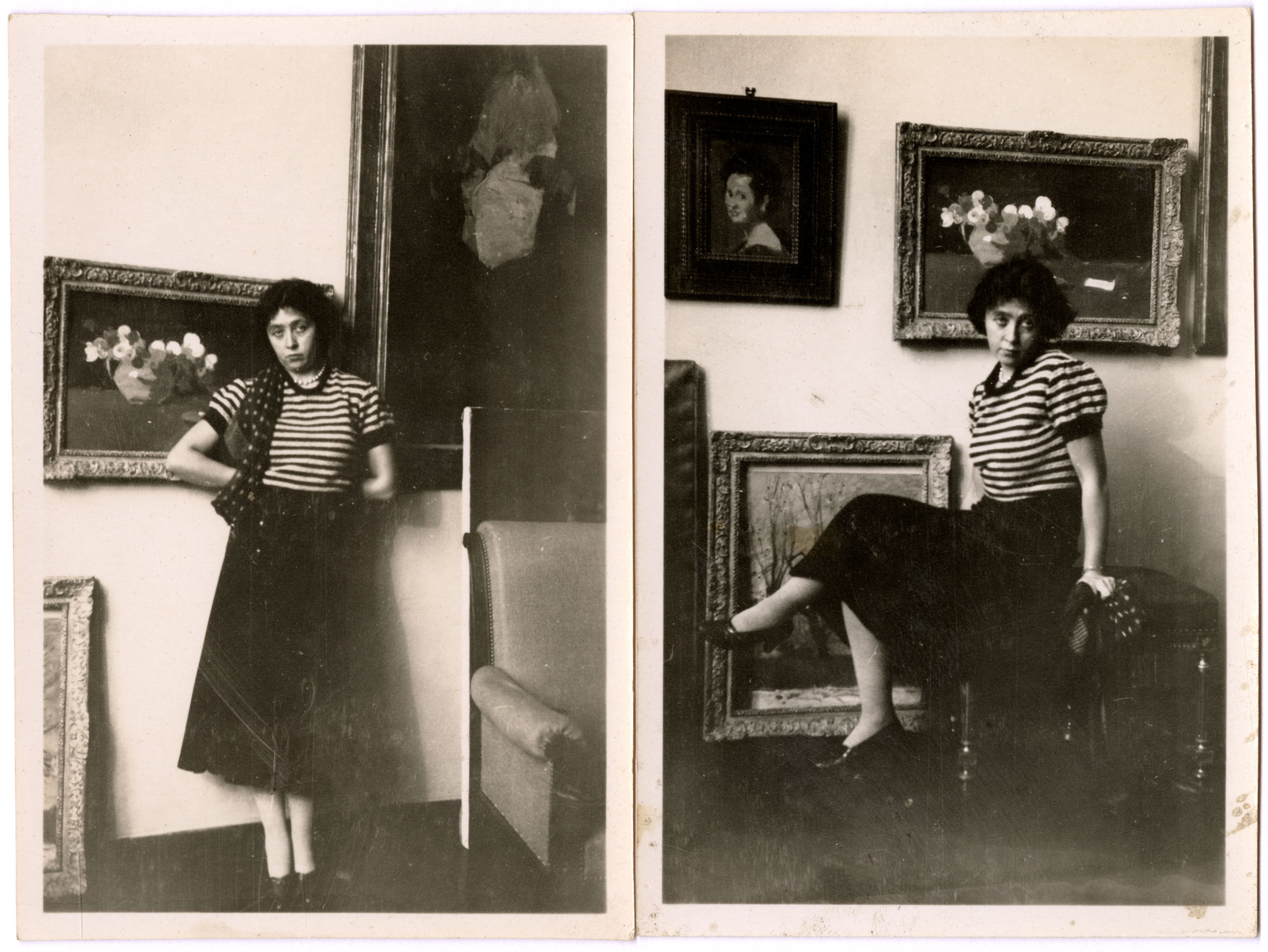 *Henriette Delavrancea in the 1920s
Notre maison. Henriette Delavrancea-Gibory
149, Mihai Eminescu Street., Bucharest, 1925 2
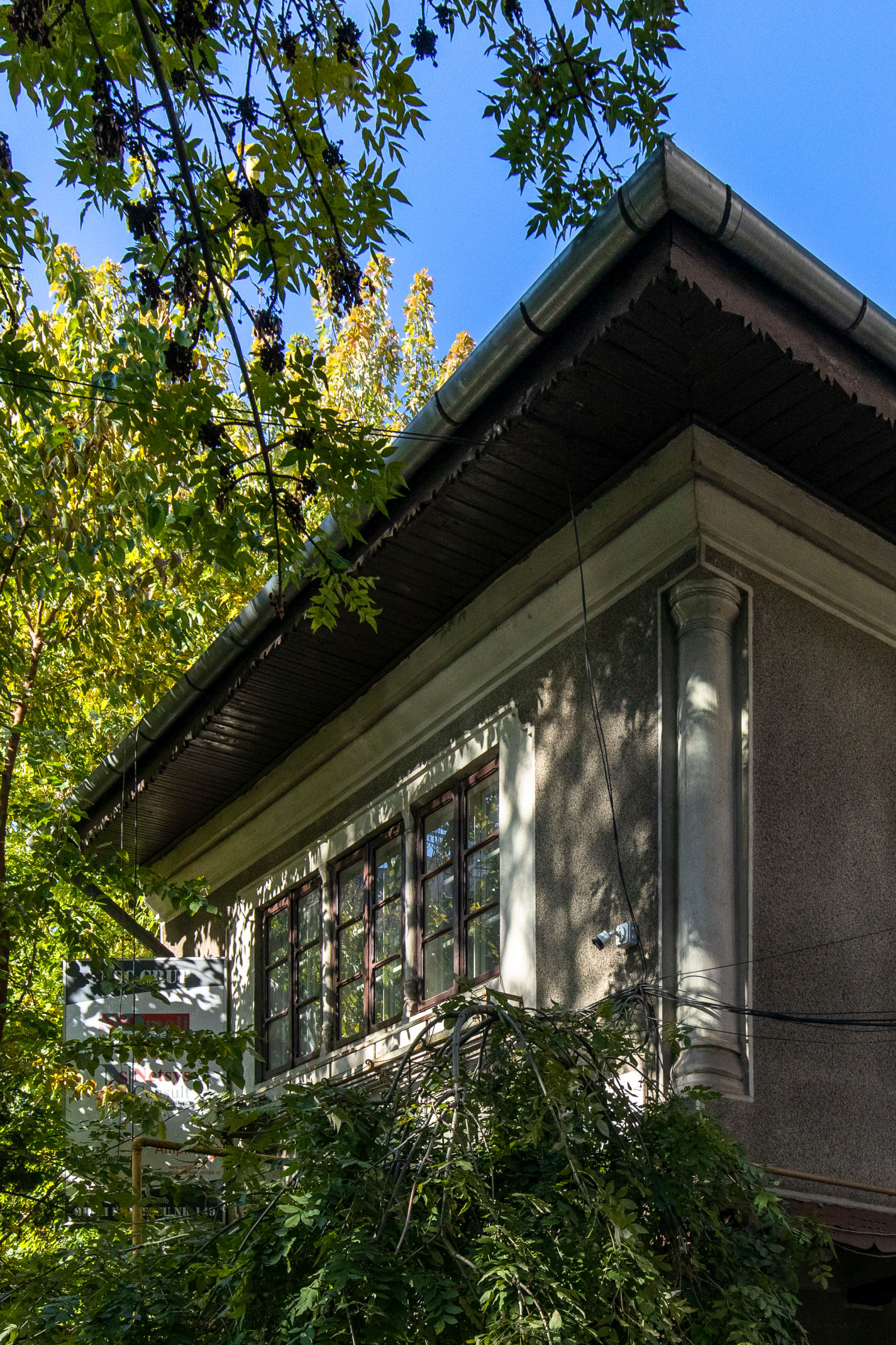 *Henriette Delavrancea’s house, today
The first local reverberations of architectural Modernism start to appear around the mid-1920s, through the practice of architects such as Marcel Iancu or Horia Creangă, although several styles coexisted around the time along with a certain institutional reticence to Modernist architecture. Despite holdbacks, translations of Le Corbusier’s or Theo van Doesburg’s texts3 are published, for instance, in the Contimporanul magazine’s issues dedicated to architecture. Thus, the local circulation of the ideas of Modern Movement’s most important advocates stirs a certain enthusiasm in Henriette Delavrancea-Gibory’s contemporaries, as they attempt to take up Functionalism as “a method to think and to build… in no case as a style”4. Under these circumstances, Henriette’s explicit positioning – although rather in her early works – against the ad litteram assimilation of the Modernist project looks, in turn, like a form of critical practice and a reflection of an attachment to the heritage of the tutelage at the Higher School of Architecture, especially in the years following Ion Mincu’s death.
What stands out since the architect’s very first projects, even under the initial form of an intention, is the controlled usage of Modernist-inspired planimetric principles, alongside the use of traditional architecture elements. Later, this way of operating sets the bases of an assumed “project”, for instance, through the series of villas at Balcic. We can therefore speak of a form of avant la lettre critical regionalism: Henriette’s project is based on “the entire evolution of architecture”5 all the while working with a local character, be it the Romanian space, or the Balkan one, for the Balcic villas. This type of referencing tradition via the filter of modernity also appears in the work of some of Henriette’s contemporaries – for instance, Octav Doicescu or G. M. Cantacuzino. However, at least in respect to the relationship between discourse and practice, Henriette adopts a position that is keener to the architectural tradition of her region of practice than other architects who had similar expressive searches. One of the first articulations of this type of language also appears in the case of her own house in Bucharest, in 149 Mihai Eminescu Street, which she designs in 1925, while still a student.
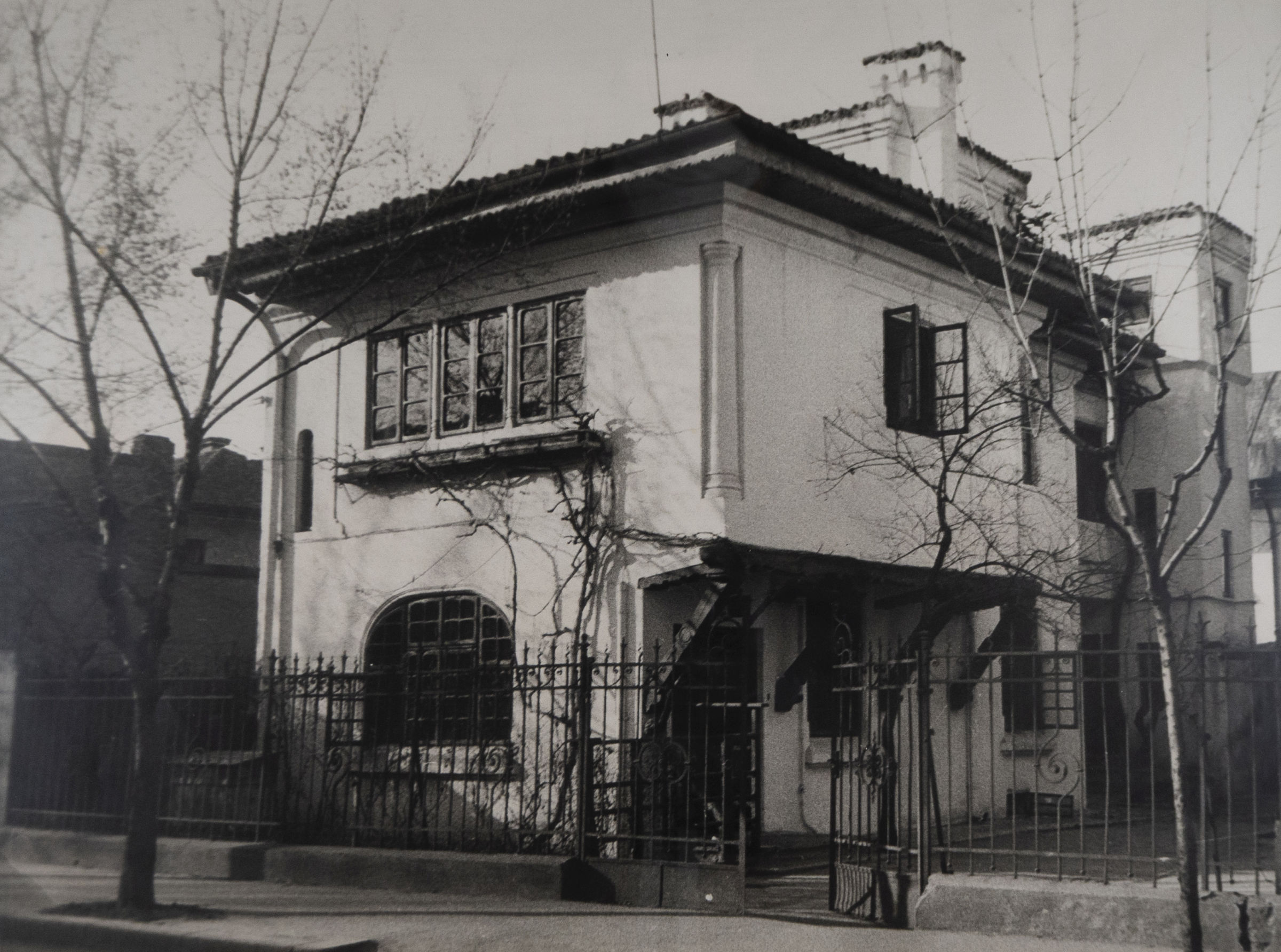 *Period photo of the extended house
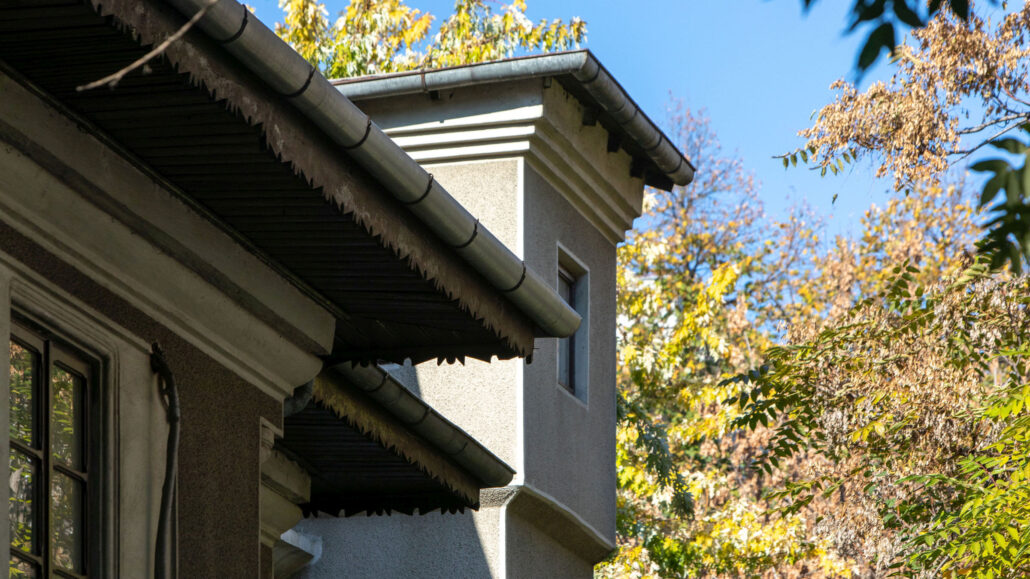
The house bears the clues to what Henriette Delavrancea-Gibory’s architecture would later become: white, with rigorous geometry, tall chimneys, the arched major ground floor windows, and the decorative woodwork. The robust wooden structural elements which take part in supporting the cantilever, the woodwork with folded and curved lines marking the upper eaves and the one marking the entrance are elements of traditional expression, while, at the intersection of the upper floor’s exterior walls, classical-inspired columns are exhibited in an almost ludic manner. Besides, seen from the street, through the transparency of the fencing, the interior elevation’s suite of vertical plans (after the 1927 extension) allows the quick reading of a well-mastered volumetric play.
There is a certain rationalist logic in how the treatment of certain details appears – they underline a particular character of Henriette’s architecture, without announcing the house’s inhabitant status quo. These details rather speak of a series of affinities: personal interpretations appear even in taking over traditional decorative motifs in the woodwork. Those are elements building a domestic, semi-urban or semi-rural setting, which is otherwise integrated in the general landscape of inter-war Bucharest: the house does not wish to become a manifest, or to distance too much from the image of the houses of traders or of the middle class of its time. It is, first and foremost, a house of the Bucharest houses at “205 Romană St.” – the building’s previous address. This is how we could describe the house’s initial aspect, nowadays diminished, both by the grey decorative plaster, the reddish-brown paint on the joinery elements, as well as by the air conditioning mounted on the facades and by the uncontrolled vegetation by the street.
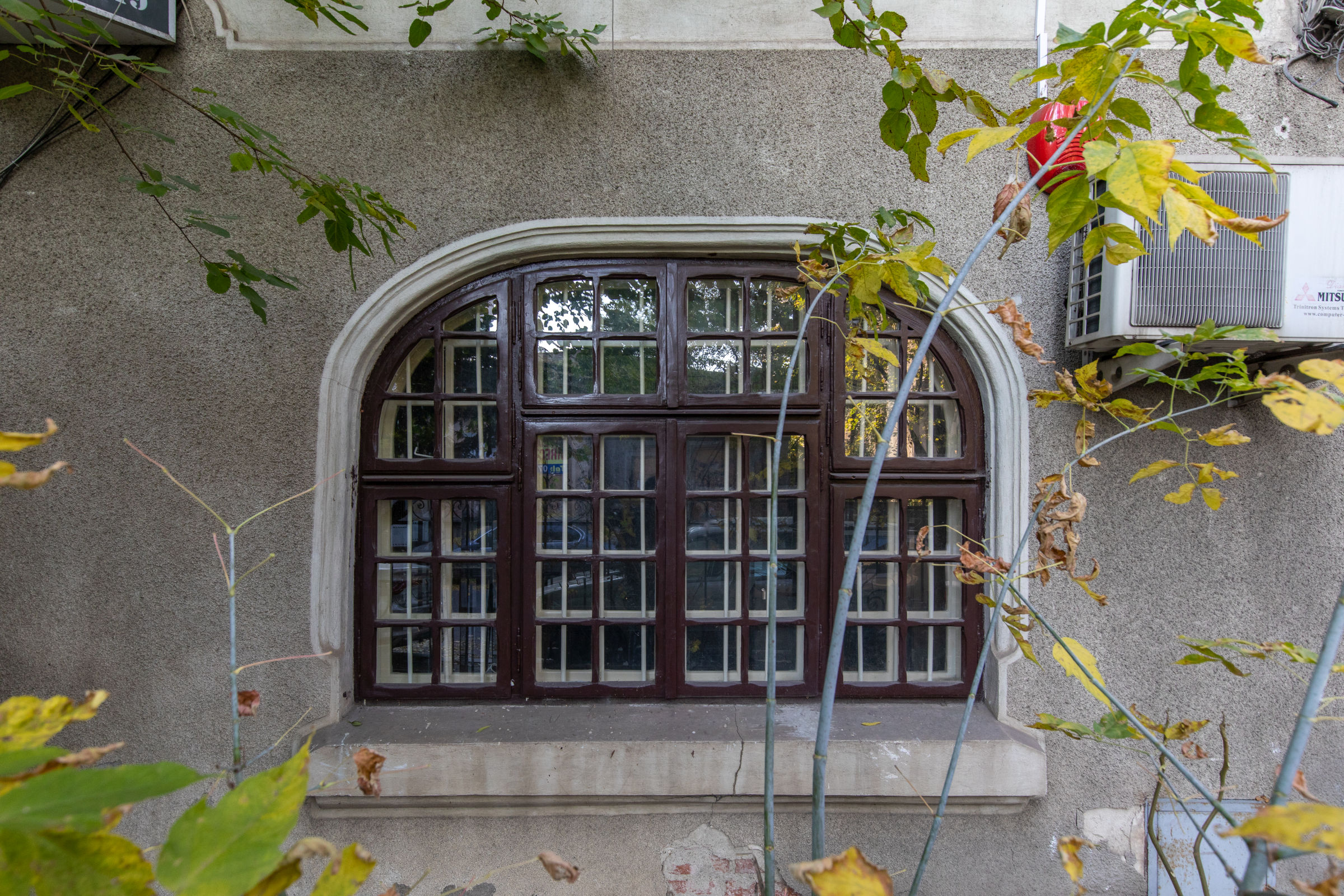 *The house today. Reversible alterations
From a functional perspective, the initial project proposes an almost minimal dwelling, rather an atelier-house than a residential villa – “un pied-à-terre d’artiste”, according to the title of one of the 1925 plans. By the street, into the ground floor, the entrance covered by the bracket opens, with a gesture suggesting a vestibule, into Henriette’s atelier, connected to the upstairs bedroom through a balanced staircase. Within the economy of this house, the generosity of the ground floor kitchen’s dimension (as compared to the atelier) and, respectively, that of the upper floor’s bathroom, represent, in fact, the only major indicator of comfort: they take up over a third of the general volume.
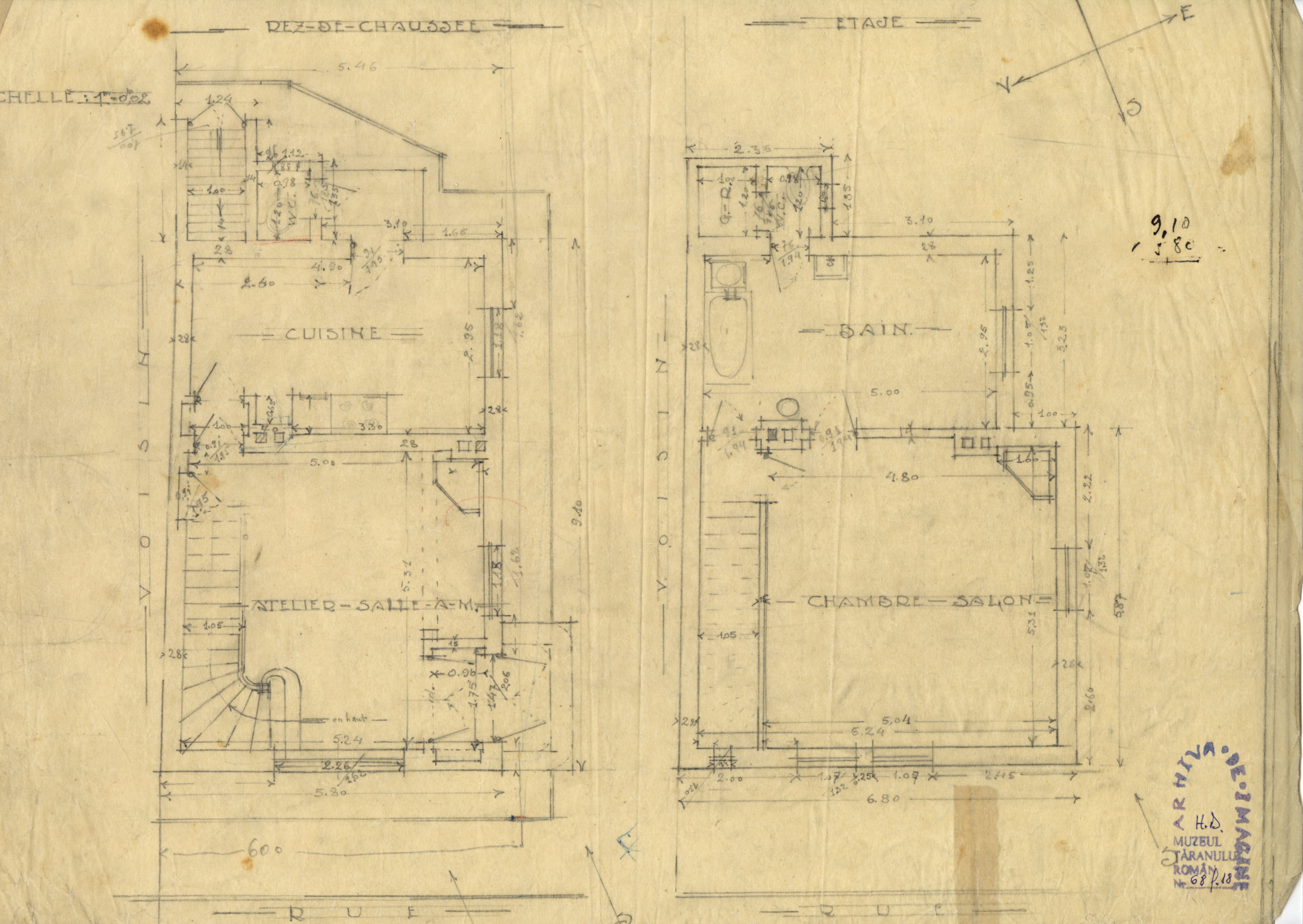 *Inititial project. Ground floor and first floor plans, with texts in French
The subsequent extension Henriette adds to the house, in 1927, brings “a ground floor room and upper floor” to the initial project, advancing on the plot.
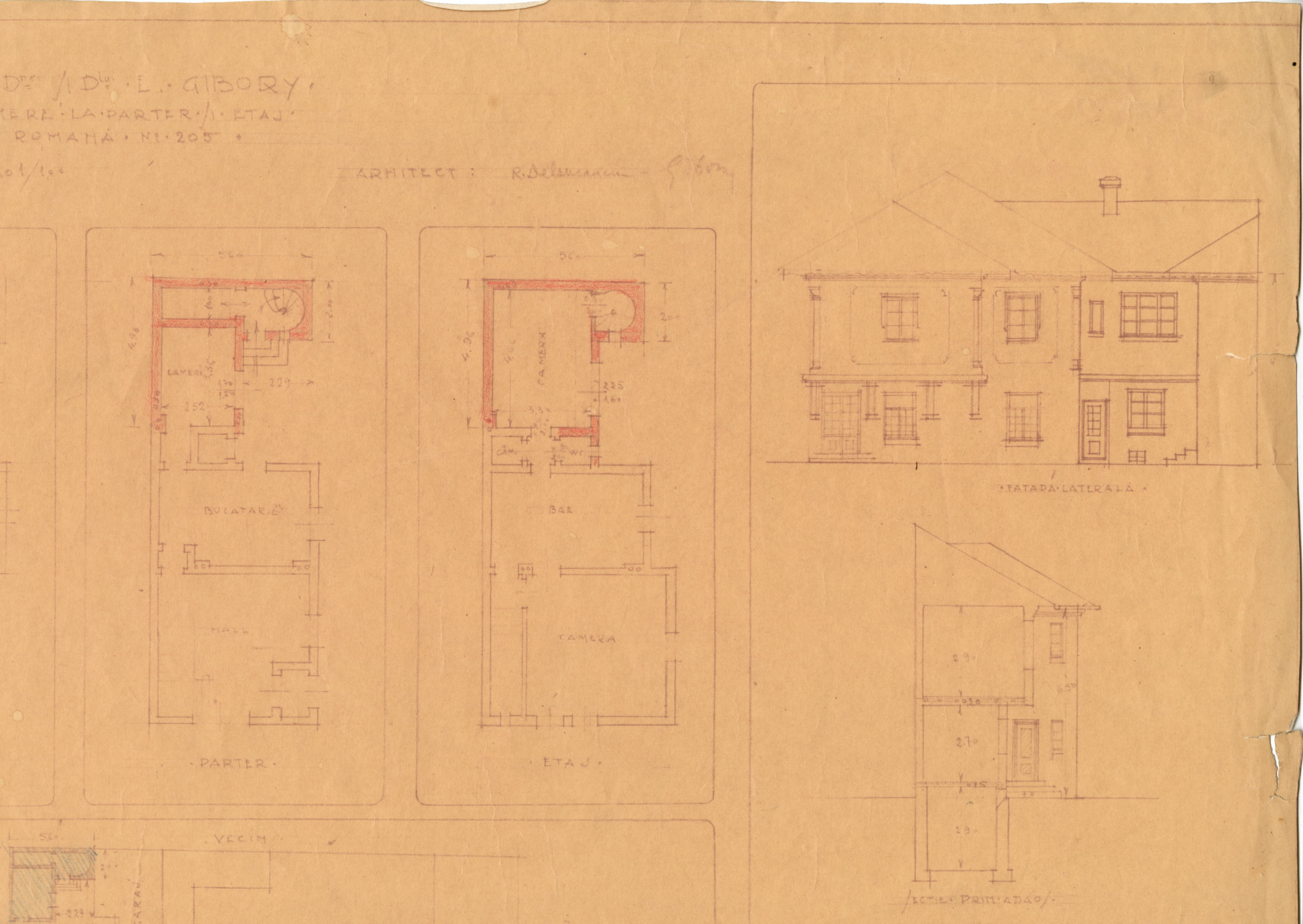 *1927 extension project. Ground floor and first floor plans, side façade
This time, this is no longer an artist’s place of resting, but “the property of Mr./Mrs. Gibory”, or “notre maison”. The addition receives its own accessway, with a helicoidal staircase leading upstairs, and is connected to the existing body via the narrow volume of an articulation which allows direct access to the kitchen on the ground floor, and, respectively, via a storage area, towards the upper-level bathroom. Over the last decade, inside the space which includes Henriette’s house, there have functioned the offices of a consultancy firm, a workshop of “electrical tools and accessories”, the offices of a locative activism initiative, and, nowadays, the seat of a bailiff.
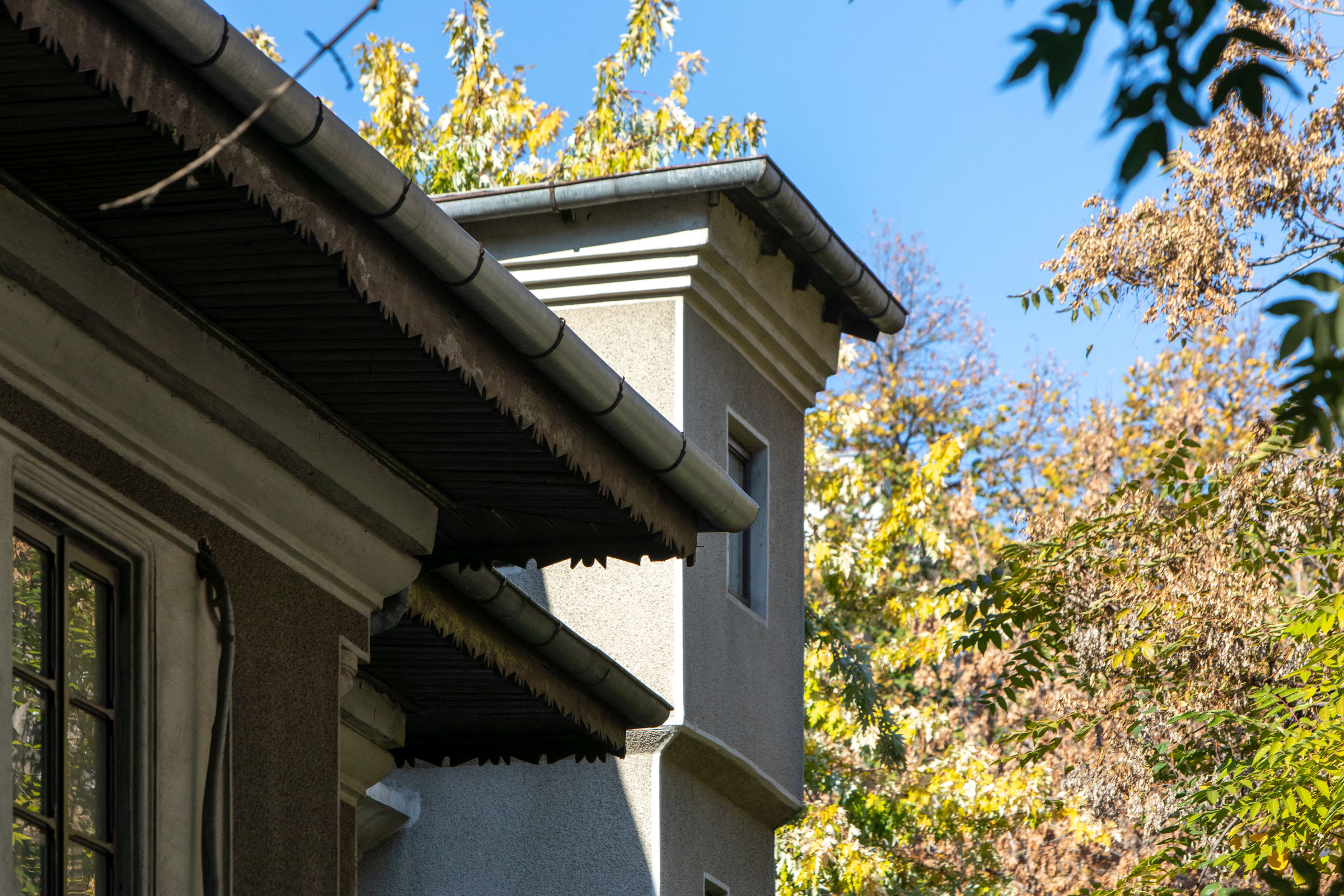
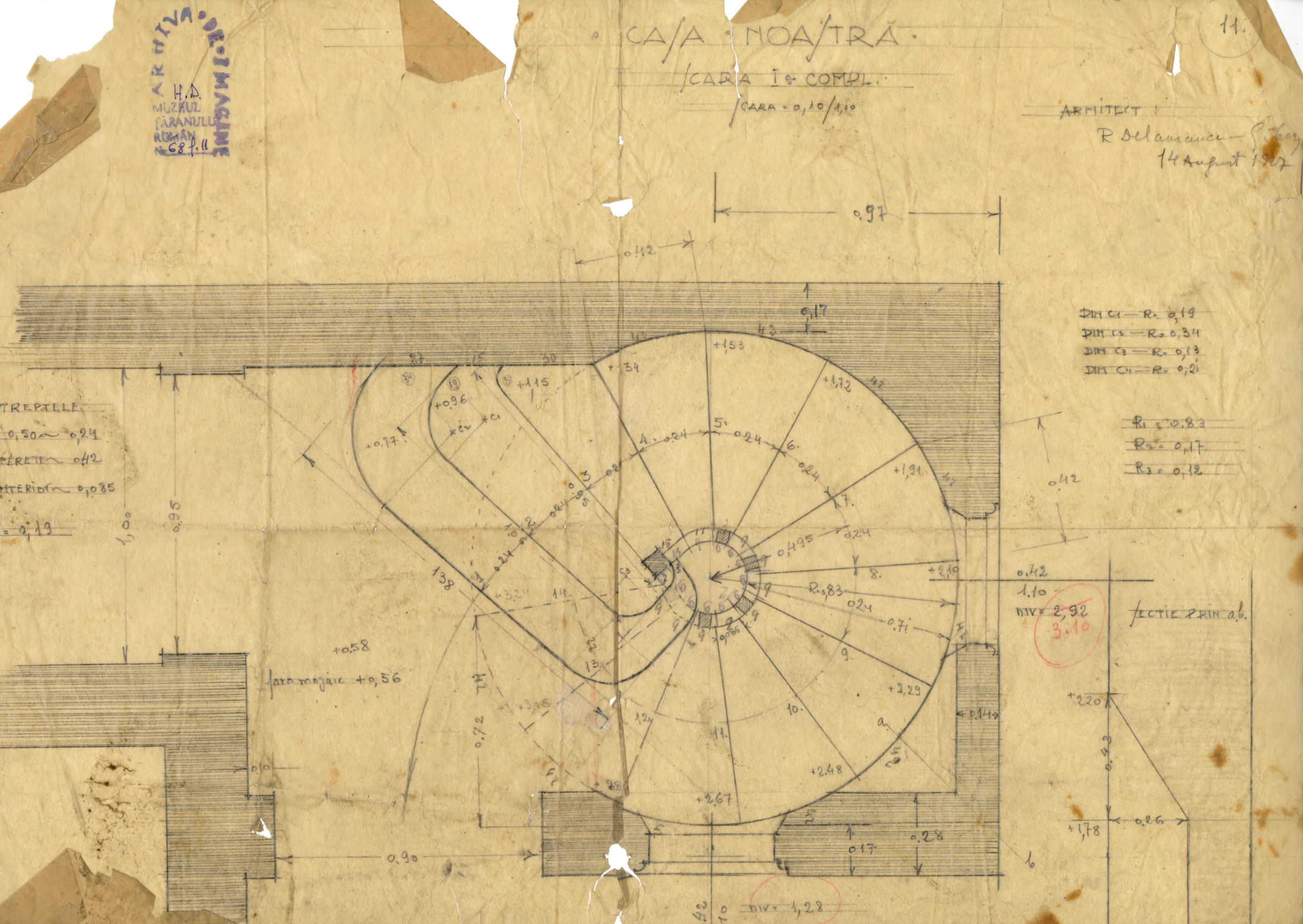 *The stairs tower, today and ina detail drawing from the extension project. “My house walls” have become “Our House”
As natural for early work, Henriette’s house is a starting point for the architect’s professional evolution. During the years of practice following the Mihai Eminescu project and until the start of the communist period, Henriette Delavrancea-Gibory approaches private and public architecture programs, proving, in many instances, a versatility which exceeds her attachment to tradition – the series of twenty-two villas, the tea pavilion and the intervention over one of the Royal Palace pavilions in Balcic, redesigning the facade of the Capitol cinema, a series of mansions and villas in Bucharest and its surroundings, the Snagov Palace, churches in Romania and Bulgaria, banks and hospitals. Many of the listed projects no longer work with ornaments, and, progressively, interpretations cease to appear at the level of decorative elements, but in working with spatial archetypes or typologies. “Man is like the architecture he builds”6 – Henriette declared critically against one of Horia Creangă’s projects. If we understand to also turn this conviction onto her own architecture, the text on the back of one of the boards in the project’s archives – “The walls of my own house” (zidurile casei mele)– becomes less about a design work, but rather about a continued work of self-definition and self-representation.
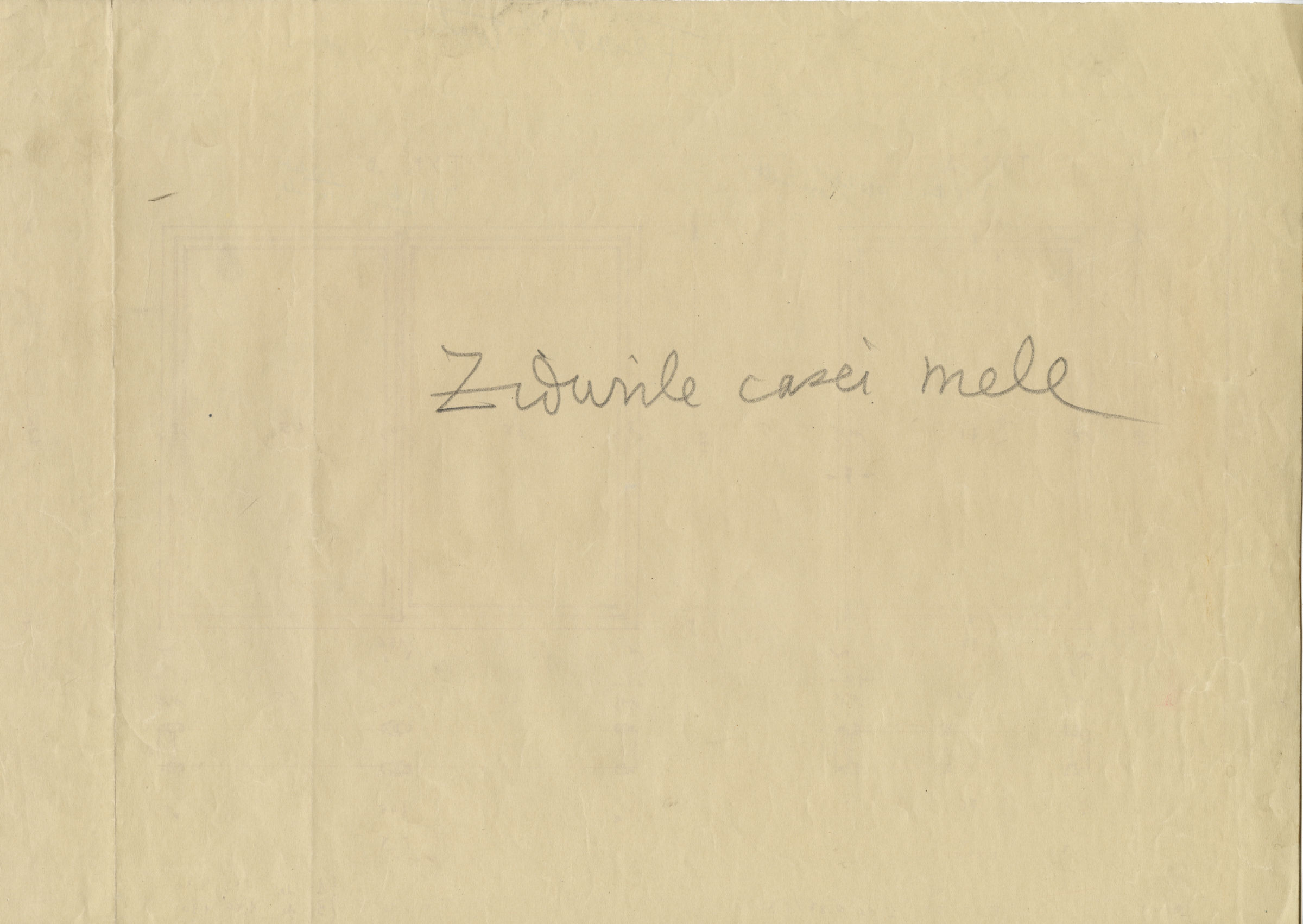 *„My house walls” (in romanian).Text on the back of one of the initial drawings for the house
The archival images and plans are part of the Henriette Delavrancea Fund, the Ethnological Archives of the National Museum of the Romanian Peasant. Photographs of the current state of the house were taken by Sabin Prodan in 2021.
A first version of the this text was published in the book „Oameni la lucru în casele lor”, Bucharest: Editura Universitară „Ion Mincu”, in partnership with Zeppelin Association and SG Studio, 2021
E1027: E – Eileen, 10 – Jean, 2 – Badovici, 7 – Gray
Eileen Gray, Roquebrune-Cap-Martin, France, 1926
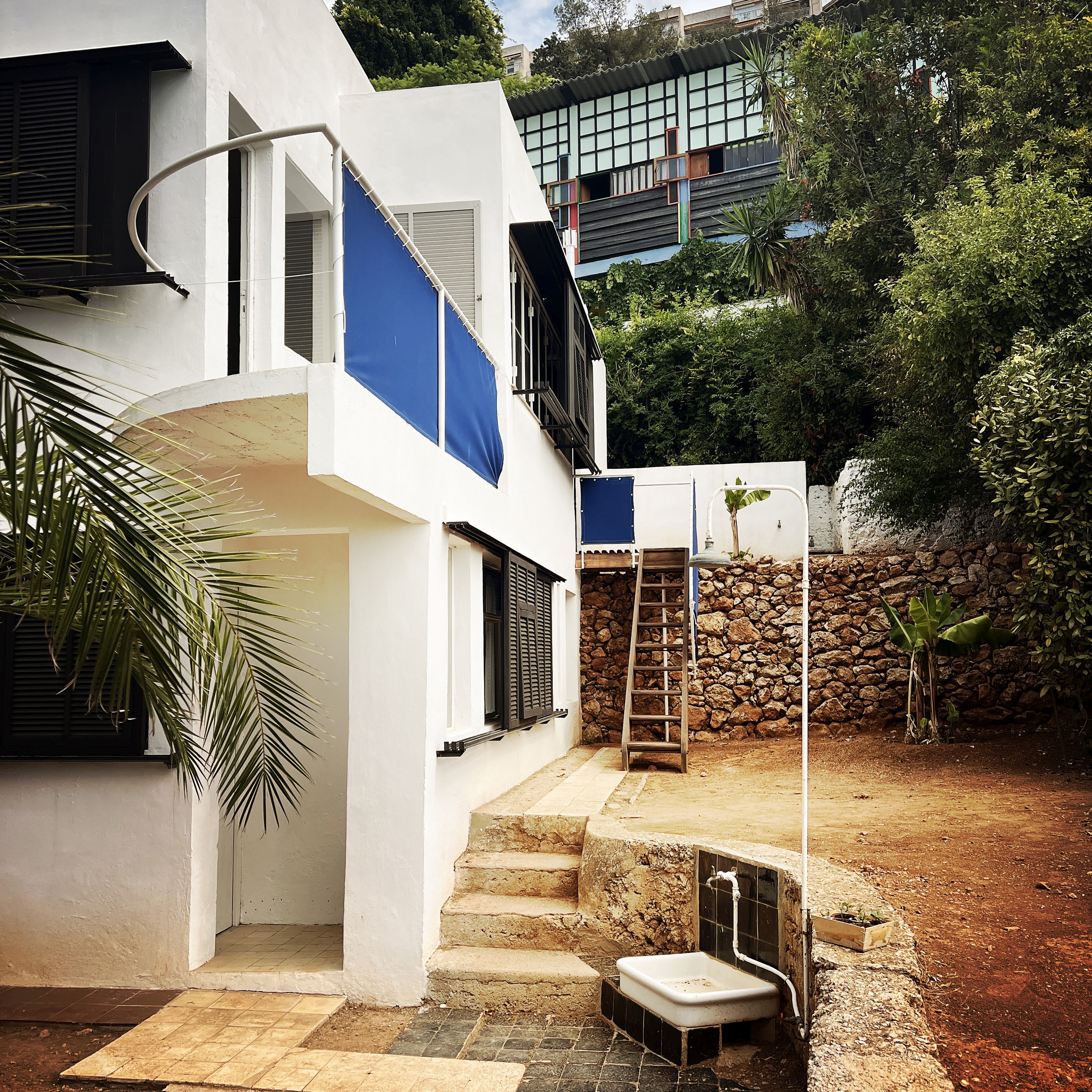
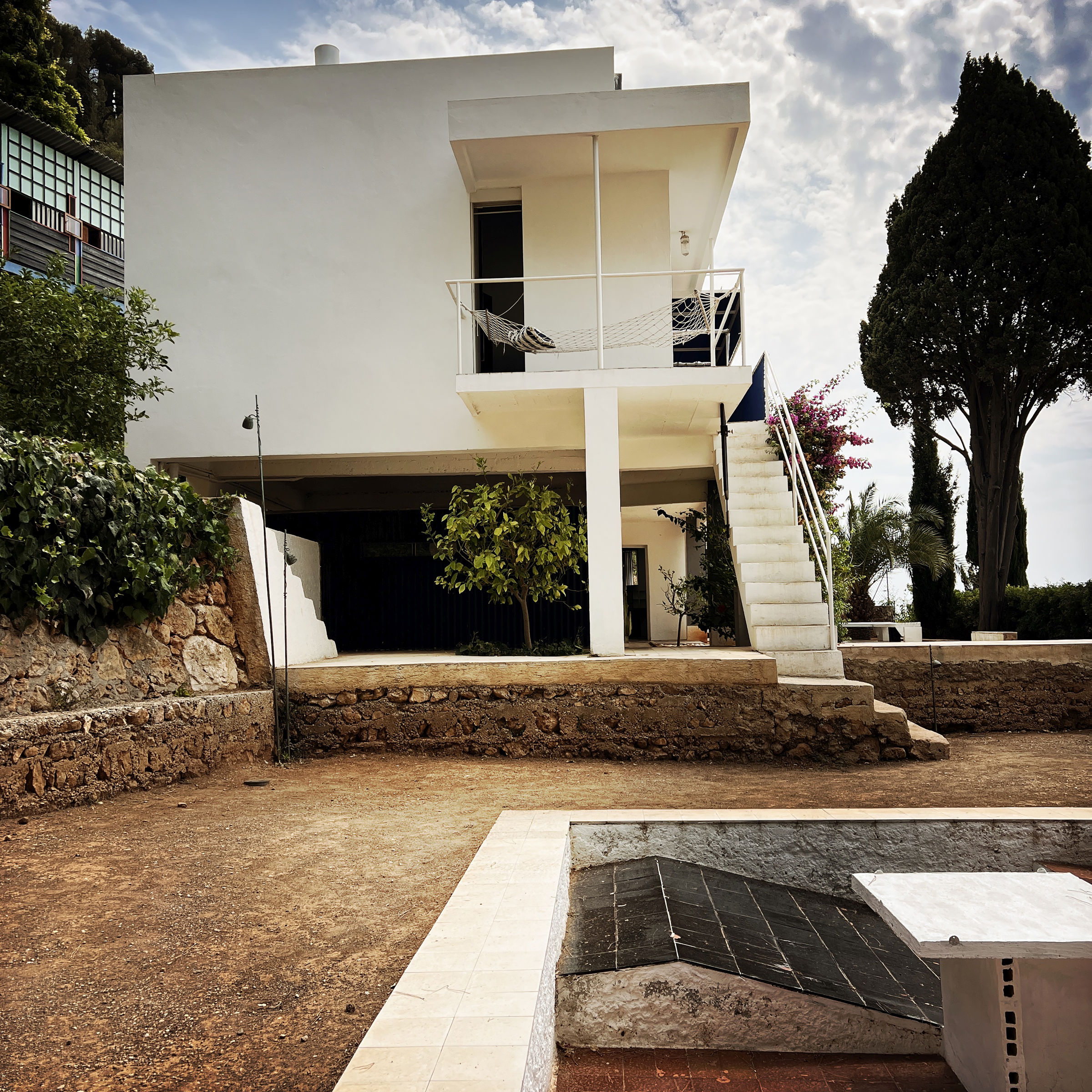 *E1027, today, after an intensive restauration (authors: Claudia Devaux, Renaud Barrès, Burkhardt Rukschcio and Philippe Deliau for Cap Moderne Association)
Eileen Gray was born in 1878, in an aristocratic Irish family; she studied at Slade School, Académie Colarossi and Académie Julian and she worked in artist Seizo Sugawara’s furniture workshop in his atelier in Paris. Around 1910, she was carrying out interior design and furniture projects for families in the Parisian aristocracy. This background is in fact the one leading to the maturity of her full-authored project of house E1027, in the mid-1920s. It is true that, although recent literature has been recovering the architect’s memory in a very responsible manner, the publications of her time record her with a certain negligence, in various versions: “Helen Gray” (Le Corbusier, My Work, 1960), “Eillen Gray” (Badovici, 1924), “Eleen Gray” (Vauxcelles, 1920-1923), “Ellen Gray” (Waldemar George, 1920-1924), “Eelen Gray” (Des Canons, des munitions?).7
Caroline Constant is the one setting (perhaps for the first time) the architect’s work in the historical context of the practice of the second half of the 20th century, in an article8 on the “nonheroic Modernism” rephrased by Eileen Gray and on the subsequent interior mural interventions in house E1027, signed by Le Corbusier.
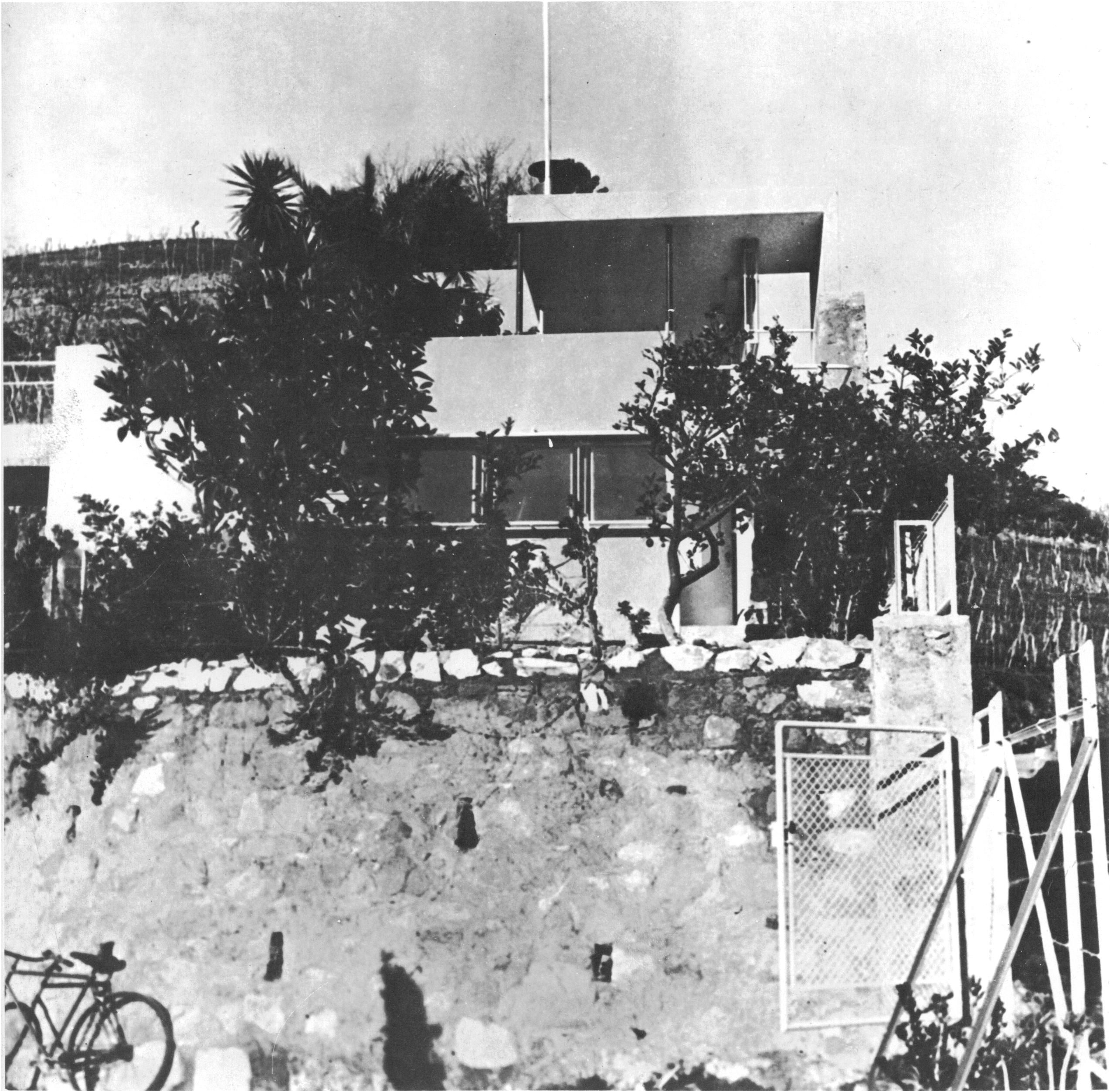
Far from practising “from the sidelines”, Gray adopts a critical stance on the expressive austerity of purist forms – architecture theoretician Joseph Rykwert writes of her inclination “for a dramatising of the essential forms to which sachlichkeit had purged building” and “against the over-intellectualising of architecture”.9 Moreover, Rykwert records house E1027 as a novelty for the general project of the Modernist house, where, in the early 1920s, the interior had not yet gained an “authored” concern.10
In 1923, Le Corbusier was publishing Vers une architecture – the moment when the five principles of modern architecture were introduced: pilotis, the roof garden, open plan, long windows, the open facade. His ideas had already started circulating, through texts published in L’Esprit Nouveau between 1920-1925, and the Villa Savoye project was to start in 1928. In the early 1920s, Eileen Gray had not designed any individual house yet – her work was still oriented towards object design and Art Deco furniture, and it had been exhibited several times at Salon D’Automne in 1922 and 192311. Later, in 1926, the friendship between Eileen Gray and Jean Badovici (the editor of L’Architecture Vivante) led to the architect’s first project: E1027, a vacation house for Badovici in Southern France, in Roquebrune-Cap-Martin. Le Corbusier’s admiration for the house leads, in 1938, to the creation of a series of mural interventions, made without the architect’s consent, as she was notified post factum. This event was the subject of several articles about the house and the architect, replacing a closer look to the house itself.
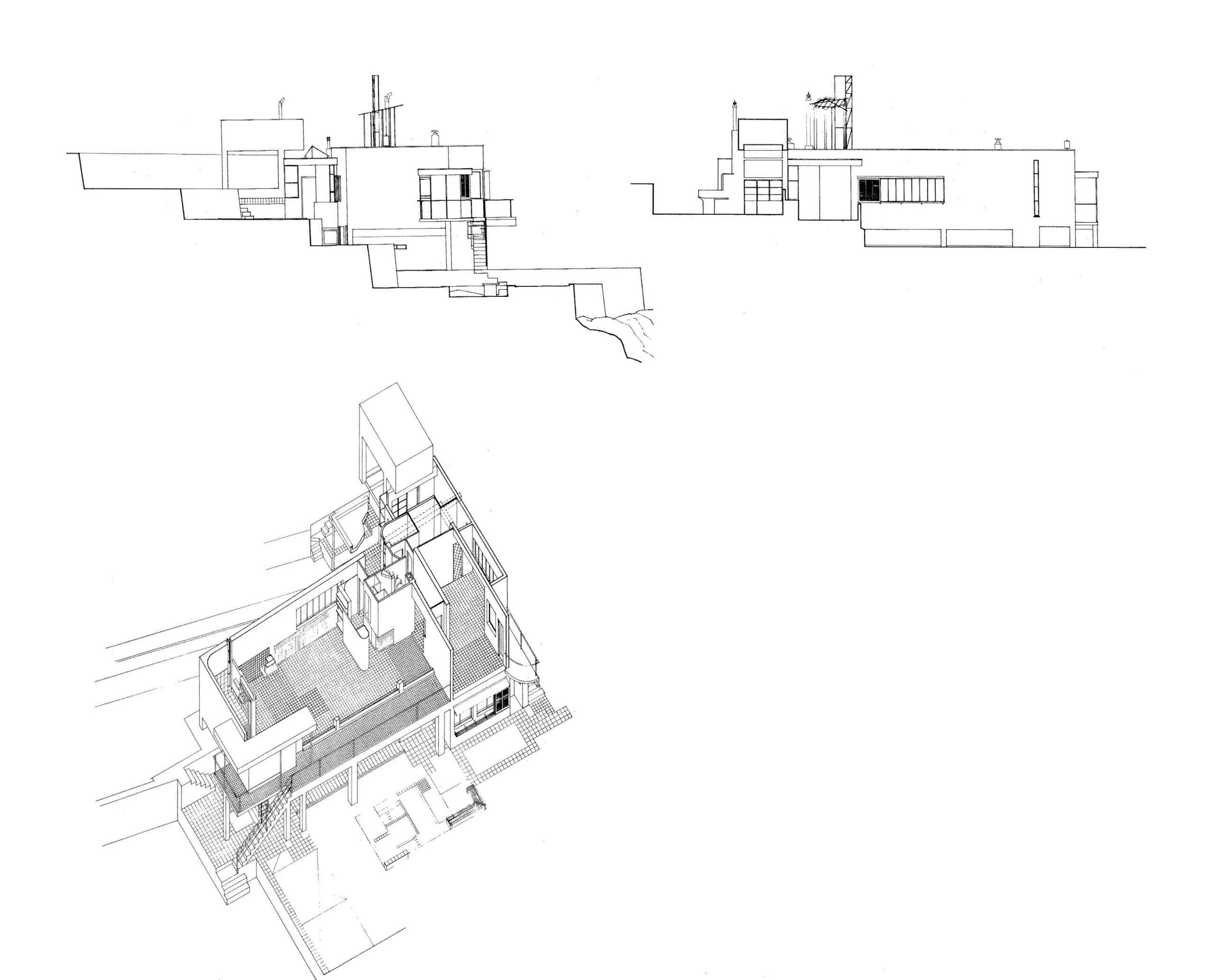 *Exploded axonometry and facades (Perspecta 13/14)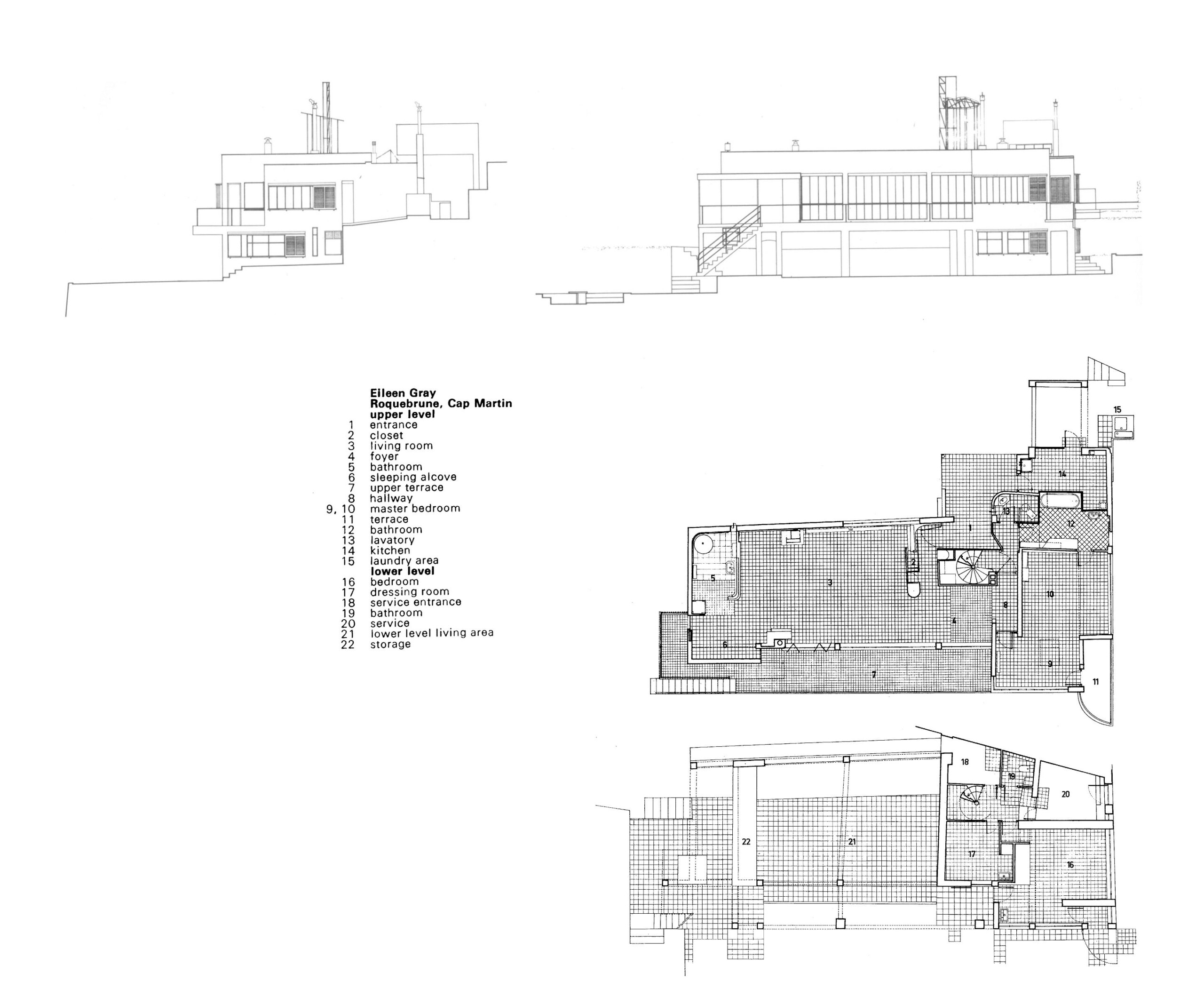
Plans (Perspecta 13/14)
Upper level plan: 1. Entrance. 2. Closet. 3. Living Room. 4. Foyer. 5. Bathroom. 6. Sleeping Alcove.7. Upper Terrace. 8. Hallway. 9,10. Master Bedroom. 11. Terrace. 12. Bathroom. 13. Lavatory. 14. Kitchen. 15. Laundry Area
Lower level plan: 16 Bedroom. 17. Dressing room. 18. Service entrance. 19. Bathroom. 20. Service. 21. Lower level living area. 22. Storage
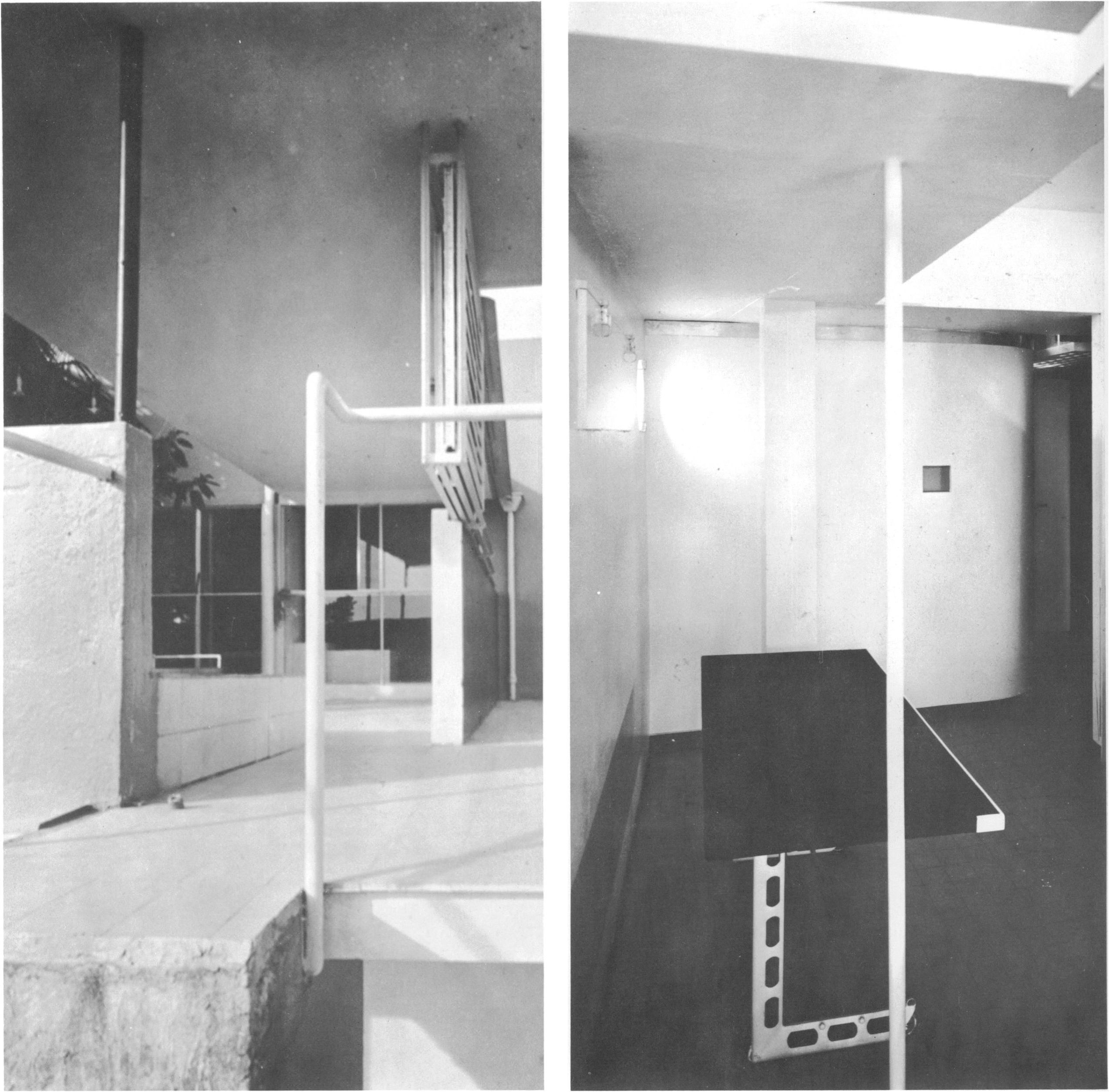
Eileen Gray designs the project starting from the interior and a series of sunlight studies, mastering the space in its smallest details: from structure to object. Besides all the furniture, which is an integral part of the project, the house’s architecture is closely connected to its surroundings and protective towards its inhabitants – a series of adjustable blinds are saving sunnier areas from excessive light and wind. The objects Eileen Gray designs for E1027 reflect her attention to the harmonious interaction of materials – I will only remind the cork-coated tea cart (to attenuate the noise of cups), a significant detail to her general attitude of care for dwelling. Moreover, most of the furniture is conceived as a “device”: nothing occupies space passively, but each element is carrying the potential of a better adjustment to the inhabitants’ needs (see the adjustable table, the Bibendum chair that takes the shape of its occupant, the complex shape of the storage furniture).
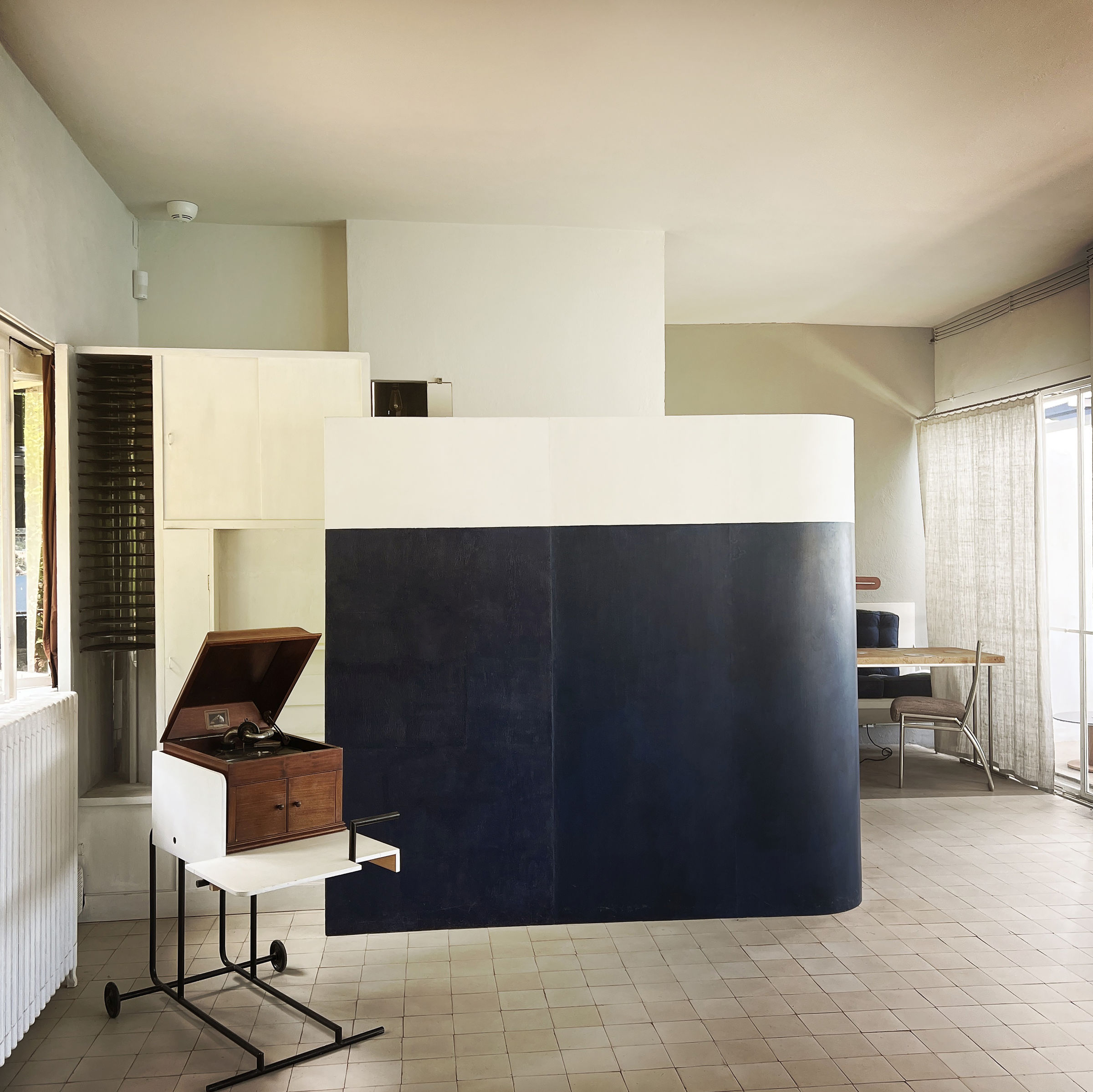
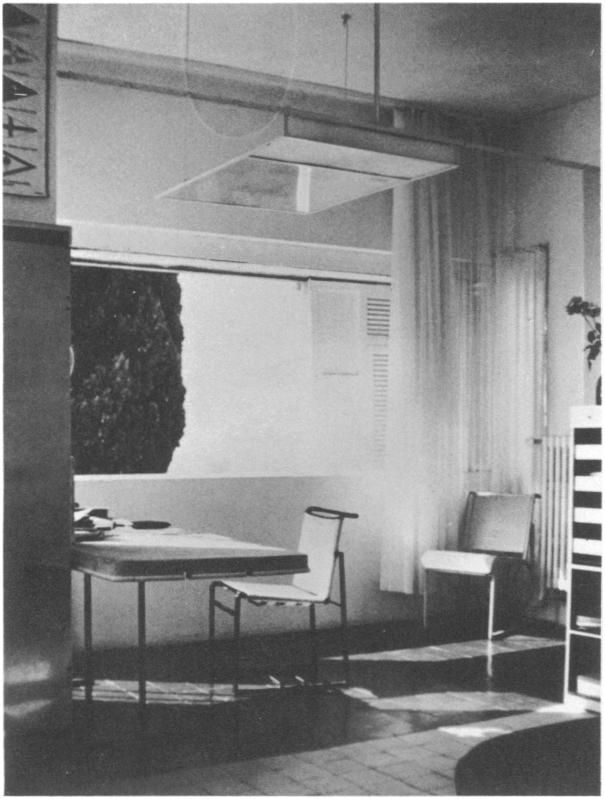
 *Upper level living room, after restauration
E1027 could be quoted as a „device” scaled to the dimensions of life in the 1920s-1930s. Well-versed in furniture design, Eileen already had the tools to imagine a functional interior space and the ability needed to design seamless transitions from one space to another, without incoherences. Although the structural concessions made to the detriment of the open plan are more than evident, circulation around the house functions in a fluid logic, with related functions which communicate openly: the entrance hall, in direct connection to the winter and summer kitchen, via an exterior space, exposes transparencies and filters which tame the Mediterranean’s bright light.
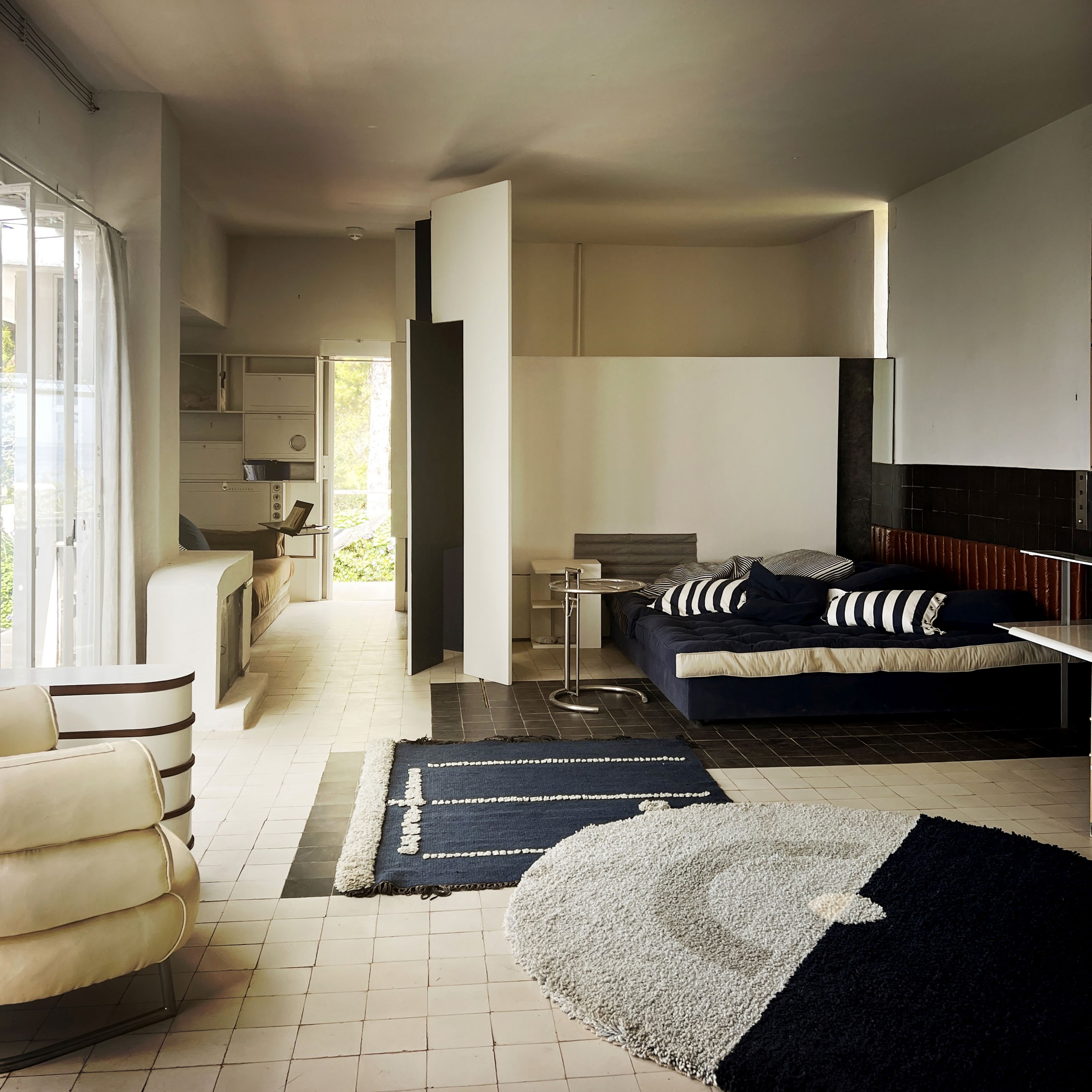
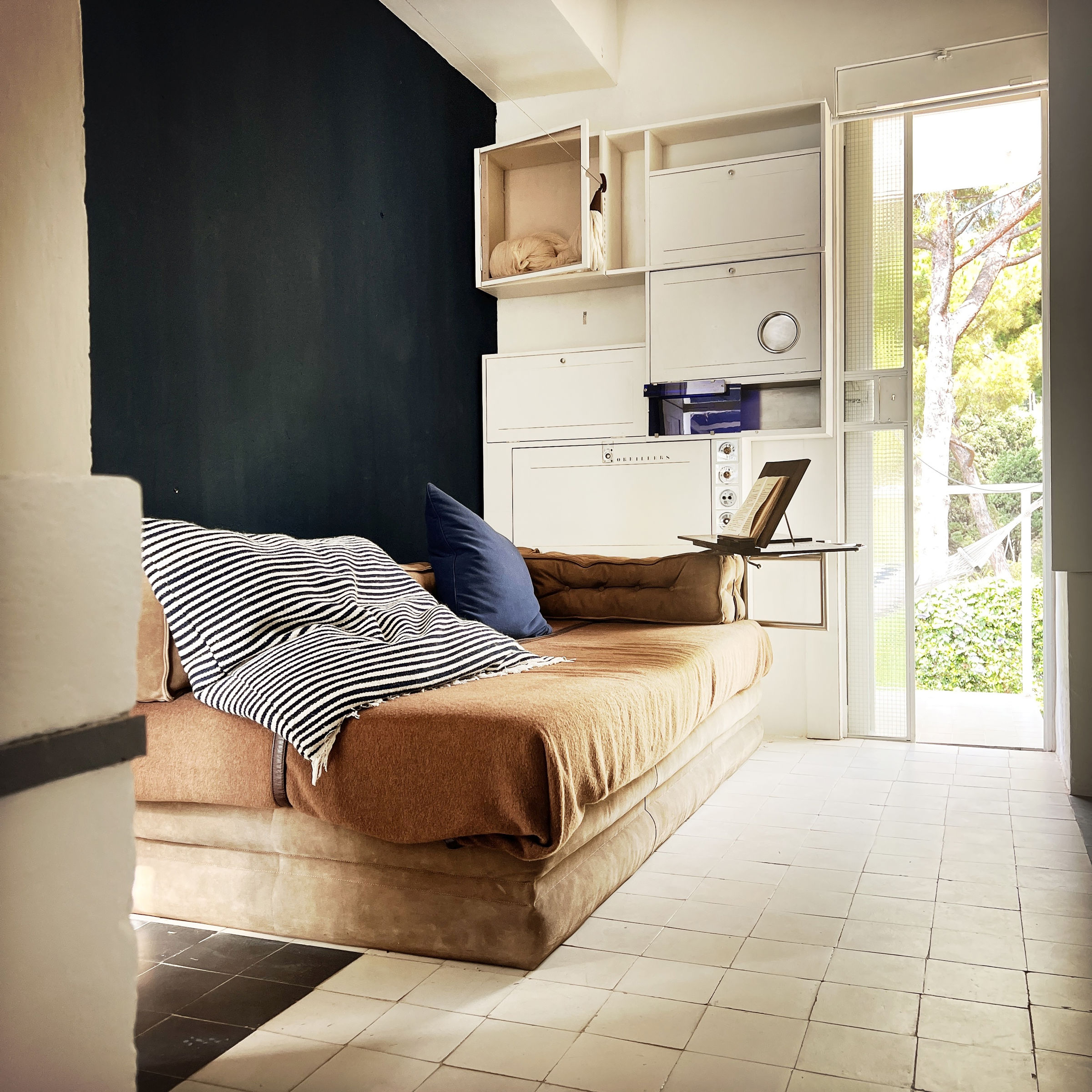
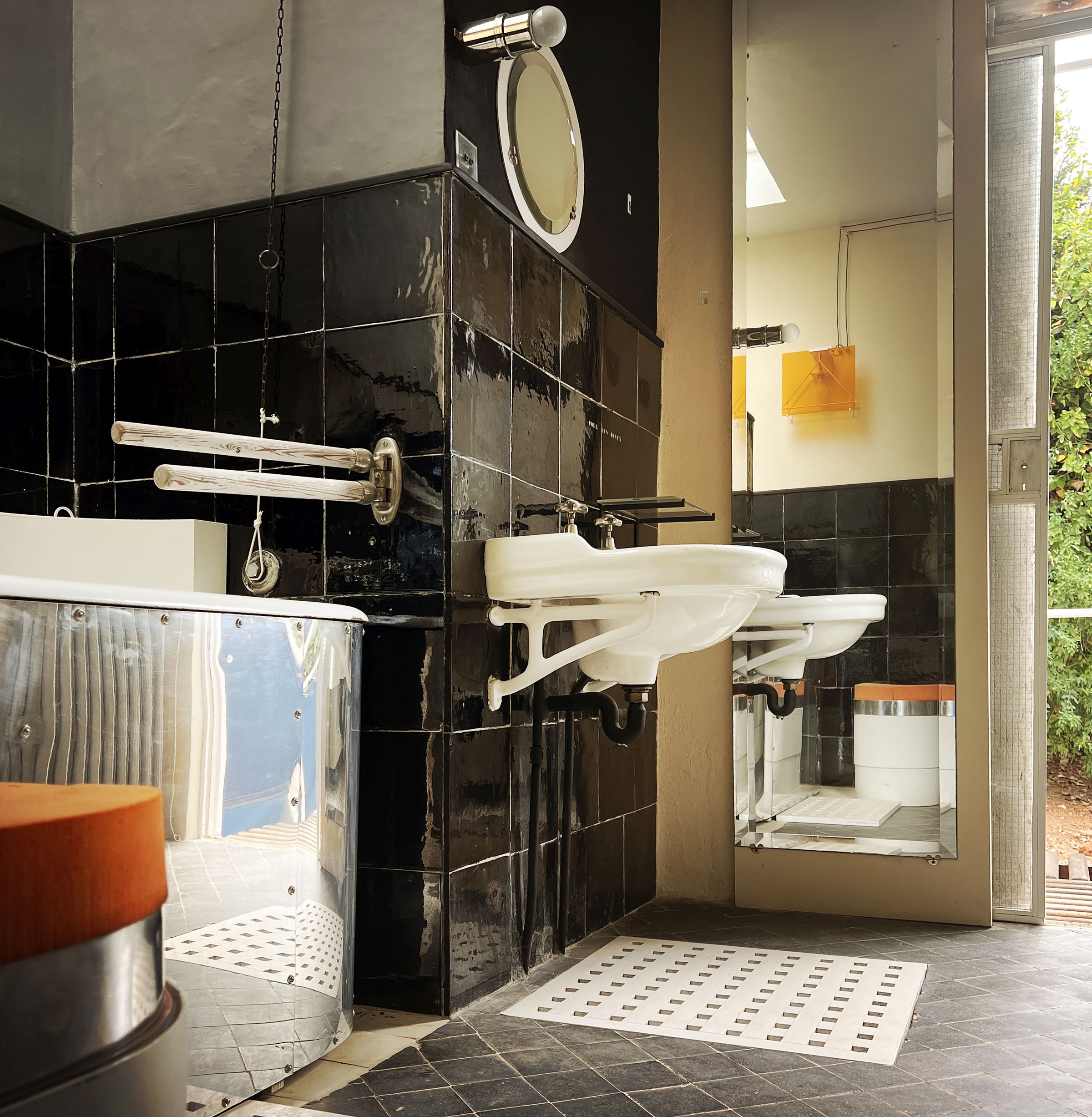
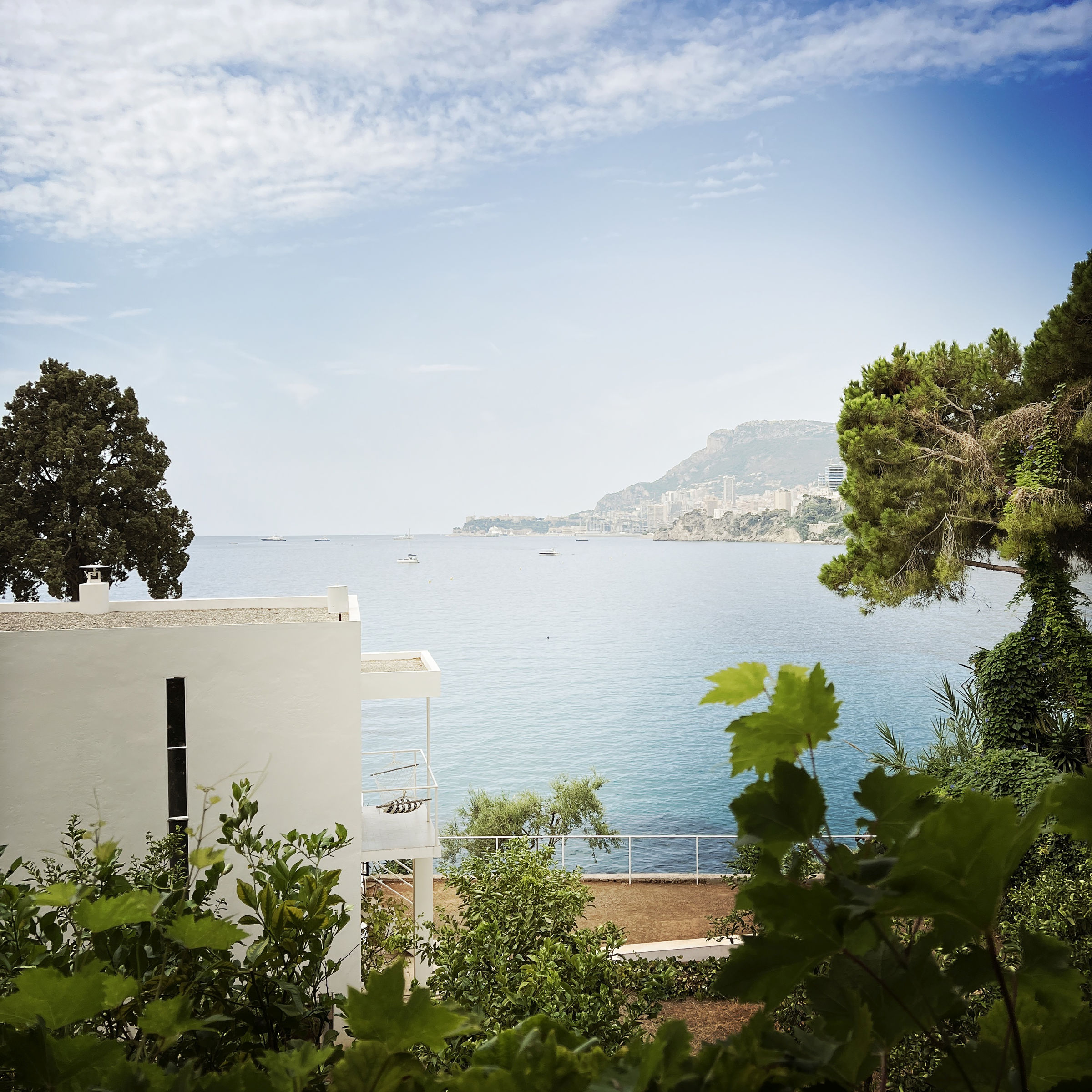
The architect’s ability to design elements with a “filter” role is also read in positioning the bedroom as a space that is accessible through an “extended path”, solving a small labyrinth: although neighbouring the living room, access is only possible through the atelier or the hallway bathroom. The house is positioned close to the beach, overlooking the water, protected through a recess of the major space towards the hill, it answers both the need for intimacy and protection, using the relief as a “shield”, and to the need for openness, exposing a porch towards the sea.
It is remarkable that, in 1929, when the general discourse was focused on automatization, Eileen Grey continued practices of vernacular traditions, of interventions “experienced” by the inhabitant, and she wove her own carpets, she designed the storage furniture by observing calculated movements in space and human automatisms. In fact, perhaps the “dramatisation” of purist approaches noticed by Rykwert in relation to Eileen Gray’s architecture could be more directly understood as a valorisation of the idea of attachment – a sum of affects, in no way detached from dwelling.
-
 +1
+1
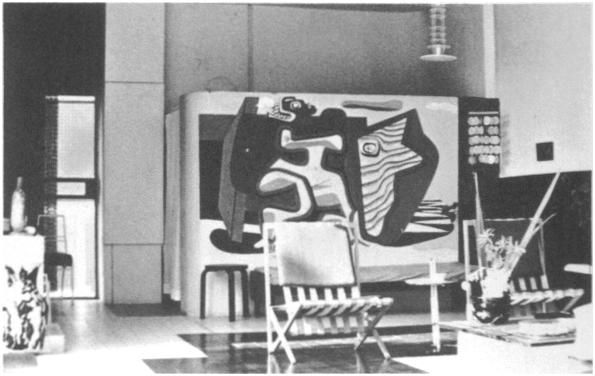
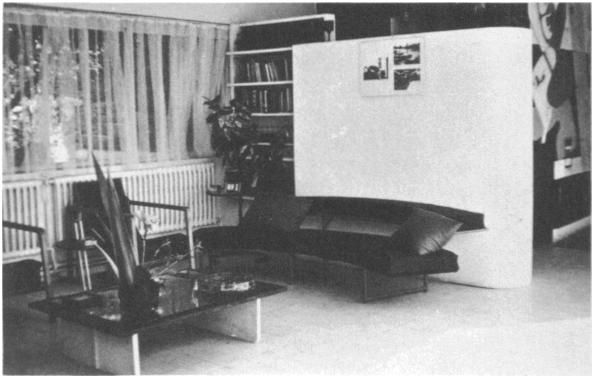
Archival images and plans were republished with permission from the Yale School of Architecture and appeared in Joseph Rykwert’s article, “Eileen Gray: Two Houses and an Interior, 1926-1933” in Volume 13/14 (1971) of Perspecta. Recent photographs were taken by arch. Mihail Amariei.
List of readings
BENTON, Tim. “E-1027 and the Drôle De Guerre.” AA Files, no. 74 (2017), p. 123-43
CONSTANT, Caroline. “E.1027: The Nonheroic Modernism of Eileen Gray”, Journal of the Society of Architectural Historians, Vol. 53, No. 3, Oakland: UC Press, 1994, p. 265-279
GHENCIULESCU, Ștefan, Andreea Drăghicescu și Dorothee Hasnaș (ed.). Oameni la lucru în casele lor, Bucharest: Editura Universitară „Ion Mincu”, in partnership with Zeppelin Association and SG Studio, 2021
HEYNEN, Hilde. Architecture and Modernity: a critique, Cambridge Mass: MIT Press, 1999
LASCU, Nicolae. Arhitectură modernă și contemporană în România – Note de curs, Universitatea de Arhitectură și Urbanism „Ion Mincu”, 2018
PATRULIUS, Radu. Horia Creangă. Omul și Opera, Bucharest: Editura Tehnică București, 1980
RYKWERT, Joseph, “Eileen Gray: Two Houses and an Interior, 1926-1933”, Perspecta, Vol 13/14 (1971), Cambridge Mass: MIT Press, p. 66-73
1 As Hilde Heynen explains in Architecture and Modernity: a critique, Cambridge Mass: MIT Press, 1999, p. 15
2 The full version of this text was first published in the book Oameni la lucru în casele lor, Editura Universitară „Ion Mincu”, in partnership with Asociaţia Zeppelin and SG Studio, 2021
3 Nicolae Lascu, Arhitectură modernă și contemporană în România – Note de curs, Universitatea de Arhitectură și Urbanism „Ion Mincu”, 2018
4 G.M. Cantacuzino in the Simetria magazine, vol I, (1939), as quoted by Radu Patrulius in Horia Creangă. Omul și Opera, Editura Tehică București, 1980, p. 38
5 a reference she makes upon the analysis and study of good practice models, in the interview “Tezaur de arhitectură românească” (Romanian Architecture Thesaurus), TVR Archives
6 Henriette Delavrancea-Gibory on the ARO building, quoted by Radu Patrulius in Horia Creangă. Omul și Opera, p. 44
7 See Tim Benton, „E-1027 and the Drôle De Guerre.” AA Files, nr. 74 (2017), p. 123-43
8 Caroline Constant, “E.1027: The Nonheroic Modernism of Eileen Gray”, Journal of the Society of Architectural Historians, Vol. 53, No. 3, Sep. 1994, University of California Press
p. 265-279
9 Joseph Rykwert, „Eileen Gray: Two Houses and an Interior, 1926-1933”, Perspecta, Vol 13/14 (1971), MIT Press, p. 69
10 „[…] it is worth remembering that at the time she [Eileen Gray] had designed the house, le Corbusier was still using Thonet chairs and club armchairs, and that [E1027] is almost contemporary with the Bauhaus masters’ house”, Idem.
11 Tim Benton speaks of the later conflict between Eileen Gray and Le Corbusier, generated by the mural intervention of the architect on the E1027 house, in “E-1027 and the Drôle De Guerre.” AA Files, no. 74 (2017), p. 123-43