
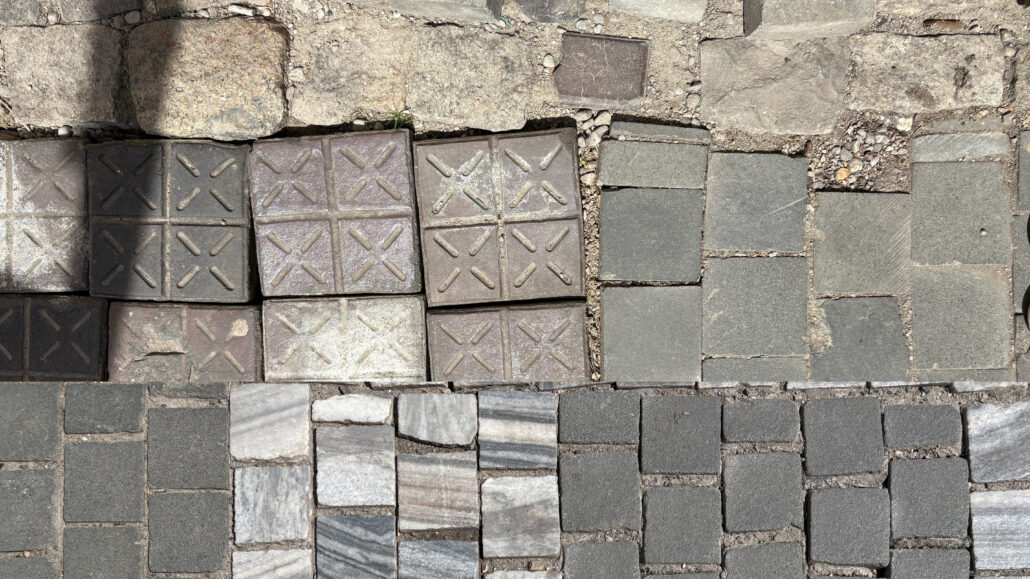
Text, photo: Cătălina Frâncu
Beneath our feet lie all sorts of textures, all sorts of materials: some harder or easier to maintain, some more expensive or cheaper, some simpler or more refined. None of this is our concern, really. We merely tread on them day in and day out without giving them a second thought; perhaps only when it rains and a rogue paving slab in Unirii Square splashes water up your leg, just to remind you that you really ought to watch your step. Once you become an expert, you can spot these jokers by their joints, or by the lingering wobble of a slab left by some other unfortunate pedestrian’s footstep.
The first ever paving in Bucharest was the planking of Calea Victoriei (then known as Mogoșoaia Bridge). A bridge over mud. A bridge made of wood. Then came the cobblestones. Cobblestones had the distinct advantage of not falling victim to termites, horses’ hooves, heels, water, or the passage of time. Moreover—though we certainly weren’t thinking about this at the time—cobblestones allowed the soil to breathe and grass to sprout, whilst offering better traction for horses’ hooves. Of course, the horses of today no longer need such things and fare much better on tarmac, but—and here I appeal to my fellow motorists—if we look at our roads, we might actually be better off driving on the uniformly uneven surface of cobblestones rather than the insidious, surprising potholes found in tarmac that, at first glance, promises a smooth journey.
But cobblestones last for hundreds, even thousands of years, as seen on Rue Saint-Jacques in Paris—stone paving dating back to the 11th century. And this means there would be no more need for annual tarmac maintenance contracts, or for hideously expensive drainage systems (as much of the water is absorbed by the sand underneath)—though, admittedly, specialist high-heel shoe shops wouldn’t stand to gain much from the arrangement either. However, a small sliver of nature would win: grass growing between the joints; the birds, who could reach their prey more easily; the pedestrians—the cobblestones alone would pacify the breakneck speeds at which we hurtle down our roads; and, whenever the state ceased to serve us, they would come in handy for the Revolution.
1793, 1848, 1917, 1968: The French Revolution, the Revolution of the Second Republic, the Russian October Revolution, May ’68—the cobblestone, the weapon of the proletariat: barricades and projectiles.
But there is no need for such things anymore. Nowadays we vote, we sign petitions, we attend audiences with our mayors. At one of these, we ought to demand the replacement of fragile tarmac with durable stone—so that the shift towards democracy can be seen right there on the ground beneath our feet.
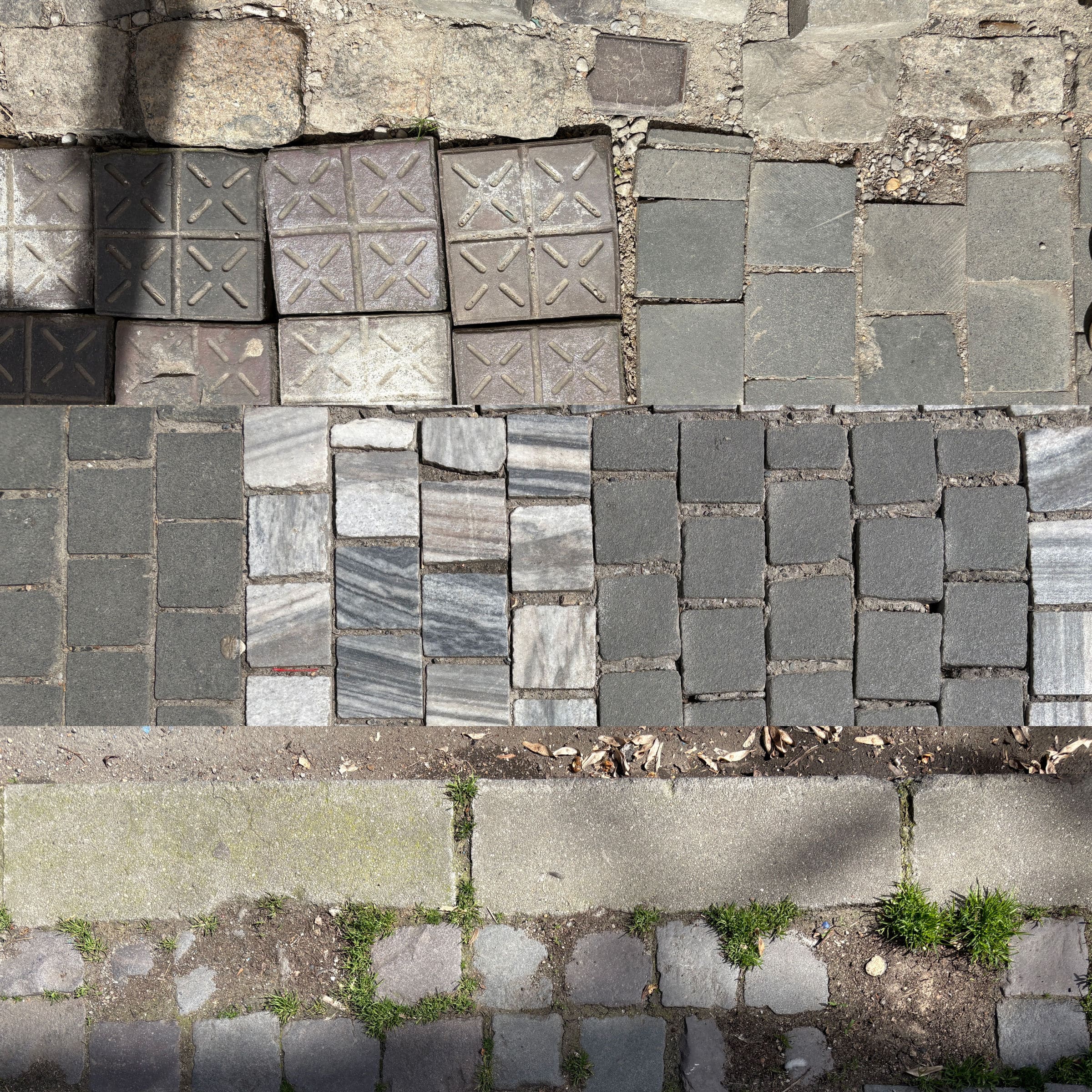
photo caption (collage):
– top: On the sidewalk in front of Casa Mincu, the headquarters of the Romanian Order of Architects, a hole in the pavement measuring approximately 1 square meter remained uncovered for two years. A few weeks ago, it was covered with concrete pavers that did not match the shape or size of the surrounding cobblestones.
– middle: Pedestrian crossing made of white marble and cobblestones, Arthur Verona Street.
– bottom: Grass growing through the cracks in the pavement, in the spring of 2026.